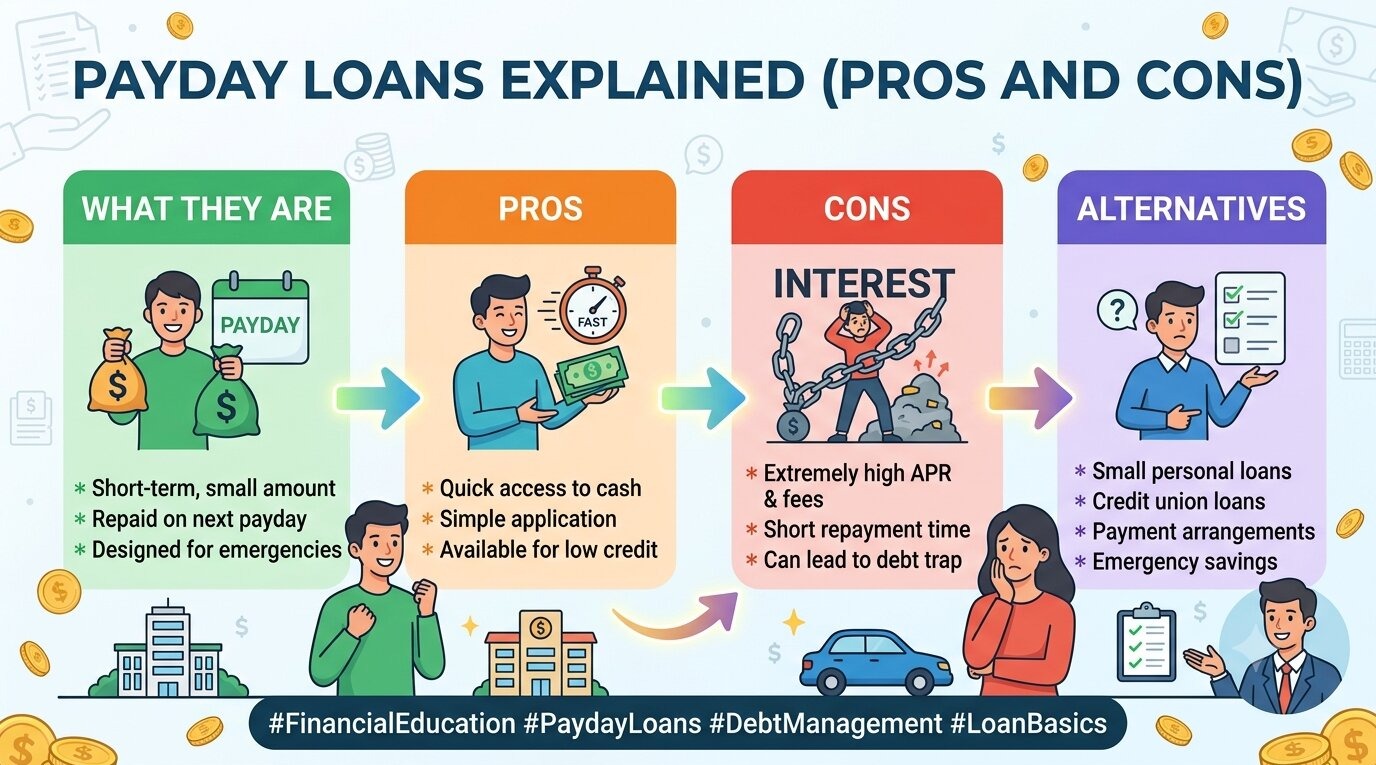
Unexpected expenses can happen to anyone. A car breaks down before payday, a medical bill arrives without warning, or an emergency home repair can't wait. In situations like these, some people turn to payday loans because they promise quick cash with minimal paperwork.
While payday loans are easy to obtain, they are also among the most expensive forms of borrowing available. What may seem like a simple short-term solution can quickly become difficult to repay if you're not careful.
In this guide, you'll learn how payday loans work, their advantages and disadvantages, real-world examples, and safer alternatives to consider before borrowing.
What Is a Payday Loan?
A payday loan is a short-term, small-dollar loan that's designed to help borrowers cover expenses until their next paycheck.
Unlike traditional personal loans, payday loans usually:
- Have small borrowing limits
- Require repayment within two to four weeks
- Charge very high fees
- Are easier to qualify for
Many payday lenders focus more on your income than your credit score, making these loans accessible to people with poor or limited credit histories.
Payday Loans at a Glance
| Feature | Simple Explanation |
|---|---|
| Loan Amount | Usually $100–$1,000 |
| Repayment Period | Typically 2–4 weeks |
| Credit Check | Often limited or not required |
| Interest Cost | Very high compared to other loans |
| Approval Speed | Often within minutes or hours |
| Best Use | True financial emergencies only |
Although payday loans provide fast access to money, convenience often comes with a significant cost.
How Does a Payday Loan Work?
The process is generally simple.
- Submit an application.
- Provide proof of income and identification.
- Receive approval.
- Get the money, sometimes on the same day.
- Repay the loan plus fees on your next payday.
Some lenders automatically withdraw the repayment from your bank account on the due date.
Because repayment happens quickly, borrowers need to be certain they'll have enough money available.
Real-World Example
Imagine Lisa's car suddenly needs a $500 repair so she can continue commuting to work.
Her next paycheck is two weeks away, and she has no emergency savings.
She takes out a $500 payday loan. When payday arrives, she must repay the original loan plus substantial fees.
If Lisa can't repay the full amount, she may need to renew or roll over the loan, leading to additional fees and making the debt even more expensive.
This example shows why payday loans should generally be considered a last resort.
Advantages of Payday Loans
Despite their drawbacks, payday loans do offer some benefits in specific situations.
Fast Approval
Many payday lenders approve applications within minutes.
If you're facing a genuine emergency, quick funding can be helpful.
Simple Application Process
Most lenders require only basic information, such as:
- Identification
- Proof of income
- Active bank account
Documentation requirements are often much lighter than traditional bank loans.
Limited Credit Requirements
Borrowers with poor credit or little credit history may still qualify.
This makes payday loans available to people who cannot access traditional financing.
Disadvantages of Payday Loans
The disadvantages often outweigh the benefits.
Extremely High Borrowing Costs
Payday loans usually carry much higher fees than personal loans or credit union loans.
Even though the loan term is short, the effective annual borrowing cost can be extremely expensive.
Short Repayment Period
Borrowers usually have only a few weeks to repay the entire balance.
This can create financial pressure if income is already limited.
Debt Cycle Risk
Many borrowers struggle to repay the loan on time.
As a result, they borrow again to cover the previous loan, creating a cycle of repeated borrowing and increasing costs.
Additional Fees
Missing the repayment deadline may result in:
- Late fees
- Additional finance charges
- Collection efforts
- Credit damage in some situations
When Might a Payday Loan Make Sense?
A payday loan should generally be considered only when all of the following apply:
- You have an unavoidable emergency.
- You know you'll be able to repay the loan in full on time.
- Other borrowing options aren't available.
- The amount needed is relatively small.
Even then, it's worth exploring alternatives before making a decision.
Better Alternatives
In many situations, borrowers have safer options.
Personal Loans
Personal loans typically offer:
- Lower interest rates
- Fixed monthly payments
- Longer repayment periods
Read How Personal Loans Work:
https://statush.com/credit-score-debt/how-personal-loans-work
Credit Union Loans
Many credit unions offer small emergency loans with lower fees than payday lenders.
Payment Plans
Some hospitals, utility companies, and repair shops allow customers to spread payments over several months without taking out a loan.
Emergency Savings
Building even a modest emergency fund can help avoid expensive borrowing in the future.
How to Avoid Payday Loan Problems
If you decide to take a payday loan, follow these practical tips:
- Borrow only the exact amount you need.
- Read every fee before signing.
- Repay the loan on time.
- Avoid renewing or rolling over the loan.
- Don't use payday loans for everyday spending.
- Compare other borrowing options first.
Responsible borrowing reduces the chance of falling into long-term debt.
Common Mistakes to Avoid
Many borrowers make avoidable mistakes when using payday loans.
Some of the most common include:
- Borrowing more than necessary
- Taking multiple payday loans at once
- Ignoring repayment deadlines
- Using payday loans for vacations or shopping
- Failing to compare alternative lenders
- Rolling over loans repeatedly
These mistakes can quickly turn a short-term solution into a long-term financial burden.
Choosing a Better Loan
If you qualify for another type of financing, it's often worth comparing your options.
For example:
- Personal loans generally have lower borrowing costs.
- Secured loans may offer better interest rates if you have collateral.
- Credit unions often provide affordable emergency loans.
Learn more in:
- Best Personal Loans for Beginners
https://statush.com/credit-score-debt/best-personal-loans-for-beginners - Secured vs Unsecured Loans
https://statush.com/credit-score-debt/secured-vs-unsecured-loans - Best Loans for Emergency Expenses
https://statush.com/credit-score-debt/best-loans-for-emergency-expenses
Final Thoughts
Payday loans can provide fast cash during genuine emergencies, but they should never be viewed as a long-term financial solution. Their short repayment periods and high borrowing costs make them one of the most expensive ways to borrow money.
Before applying, compare all available alternatives, understand every fee, and make sure you can comfortably repay the loan on time. Whenever possible, choosing a lower-cost borrowing option—or building an emergency savings fund—will leave you in a stronger financial position.
Learning about different loan types, repayment strategies, and borrowing costs can help you make smarter financial decisions and avoid unnecessary debt in the future.
Related Articles
- Types of Loans in the USA Explained
https://statush.com/credit-score-debt/types-of-loans-in-the-usa-explained - How Interest Works on Loans
https://statush.com/credit-score-debt/how-interest-works-on-loans - Best Loans for Emergency Expenses
https://statush.com/credit-score-debt/best-loans-for-emergency-expenses - Loan Repayment Strategies
https://statush.com/credit-score-debt/loan-repayment-strategies - Smart Borrowing Tips
https://statush.com/credit-score-debt/smart-borrowing-tips