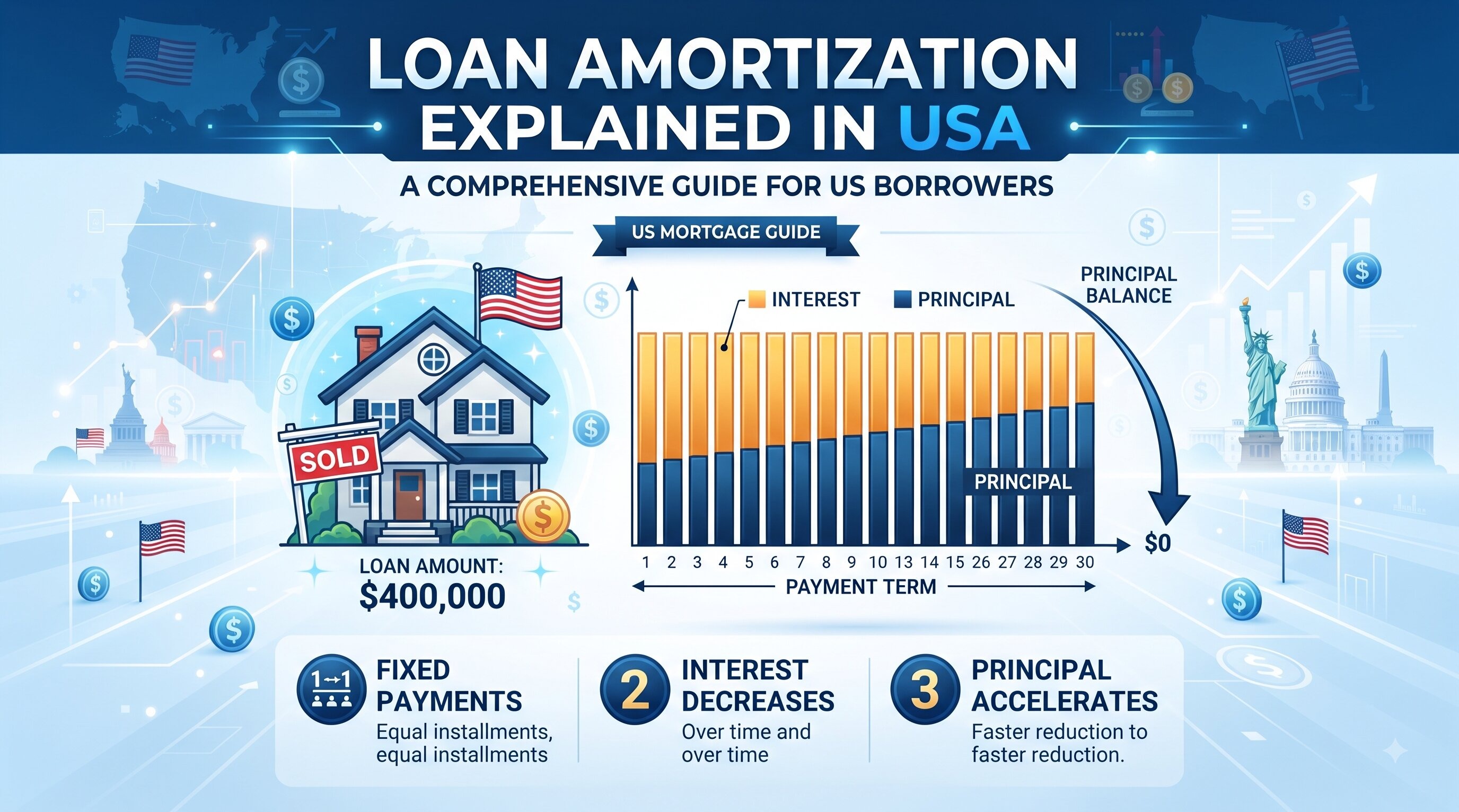
When you take out a loan, your monthly payment usually stays the same, but where that money goes changes over time. At first, a larger portion of your payment covers interest. As your loan balance decreases, more of each payment goes toward reducing the amount you originally borrowed.
This process is called loan amortization.
Understanding amortization helps you see how loans are repaid, why early payments mostly cover interest, and how making extra payments can help you become debt-free faster. Whether you're borrowing for a home, a car, or a personal expense, knowing how amortization works can help you make smarter financial decisions.
What Is Loan Amortization?
Loan amortization is the process of paying off a loan through regular scheduled payments over a fixed period.
Each payment usually includes two parts:
- Principal – The amount that reduces your loan balance.
- Interest – The cost of borrowing money.
Although your monthly payment often remains the same, the proportion of principal and interest changes throughout the loan term.
If you're new to borrowing, read How Interest Works on Loans:
https://statush.com/credit-score-debt/how-interest-works-on-loans
Loan Amortization at a Glance
| Term | Simple Explanation |
|---|---|
| Principal | The amount you borrowed |
| Interest | The lender's charge for lending money |
| Monthly Payment | Regular payment made each month |
| Loan Term | Total time to repay the loan |
| Amortization Schedule | A breakdown of each payment showing principal and interest |
Understanding these terms makes it easier to read your loan statements and compare loan offers.
How Does Loan Amortization Work?
When your loan begins, your outstanding balance is at its highest.
Since interest is calculated on the remaining balance, the lender charges more interest during the early months.
As you continue making payments:
- Your loan balance decreases.
- Interest charges gradually become smaller.
- More of each payment goes toward reducing the principal.
Eventually, near the end of the loan, most of your monthly payment goes toward paying off the remaining balance rather than interest.
Real-World Example
Imagine you borrow $25,000 for a car.
Your loan has:
- A fixed interest rate
- A five-year repayment term
- Equal monthly payments
During the first year, a significant portion of each payment covers interest because your balance is still high.
By the fourth and fifth years, your remaining balance has become much smaller. As a result, most of your monthly payment goes toward paying down the principal rather than interest.
Even though the monthly payment stays about the same, how it's divided changes every month.
What Is an Amortization Schedule?
An amortization schedule is a table showing exactly how every loan payment is divided throughout the life of the loan.
It typically includes:
- Payment number
- Payment date
- Monthly payment amount
- Interest paid
- Principal paid
- Remaining loan balance
Many lenders provide this schedule when your loan is approved.
Reviewing it helps you understand how your balance decreases over time.
Why Does Amortization Matter?
Understanding amortization helps borrowers make better financial decisions.
It Shows the True Cost of Borrowing
Many people look only at the monthly payment.
An amortization schedule reveals how much interest you'll actually pay throughout the loan.
It Explains Why Early Payments Feel Slow
Some borrowers are surprised that their loan balance doesn't decrease quickly at first.
That's because early payments contain a larger interest portion.
Understanding amortization helps set realistic expectations.
It Helps You Plan Extra Payments
Knowing how your payments are applied makes it easier to see the benefits of paying extra toward the principal.
Benefits of Making Extra Principal Payments
One of the biggest advantages of understanding amortization is realizing how powerful extra principal payments can be.
Even small additional payments may:
- Reduce your remaining balance faster.
- Lower total interest costs.
- Shorten your repayment period.
- Help you become debt-free sooner.
For example, adding just a small amount to each monthly payment throughout the loan could save hundreds—or even thousands—of dollars in interest.
Learn more in What Is Loan Prepayment?:
https://statush.com/credit-score-debt/what-is-loan-prepayment
Which Loans Use Amortization?
Many common loans follow an amortization schedule.
These include:
- Personal loans
- Auto loans
- Mortgages
- Home equity loans
- Some business loans
Each loan may have a different repayment period, but the basic concept remains the same.
Read more:
- How Personal Loans Work
https://statush.com/credit-score-debt/how-personal-loans-work - How Car Loans Work
https://statush.com/credit-score-debt/how-car-loans-work
Factors That Affect Amortization
Several factors influence how quickly your loan balance decreases.
Loan Amount
Larger loans usually result in larger monthly payments and higher total interest.
Interest Rate
Higher interest rates increase the portion of each payment that goes toward interest.
Loan Term
Longer repayment periods lower monthly payments but generally increase the total interest paid.
Extra Payments
Additional payments toward the principal accelerate the amortization process and reduce total borrowing costs.
Practical Tips for Borrowers
If you're taking out a loan, these tips can help you save money over time.
- Review your amortization schedule before signing.
- Understand how much interest you'll pay overall.
- Make extra principal payments whenever possible.
- Choose the shortest loan term you can comfortably afford.
- Avoid missing payments, as late fees increase borrowing costs.
- Refinance if significantly lower interest rates become available.
Small adjustments today can lead to meaningful savings throughout the life of your loan.
Common Mistakes to Avoid
Many borrowers misunderstand how amortization works.
Avoid these common mistakes:
- Looking only at the monthly payment.
- Ignoring the total interest paid.
- Assuming early payments mostly reduce the principal.
- Choosing an unnecessarily long repayment term.
- Missing opportunities to make extra principal payments.
- Not reviewing the amortization schedule before accepting a loan.
Understanding the full repayment process helps you make more informed borrowing decisions.
Can You Change an Amortization Schedule?
In many cases, yes.
Your repayment schedule may change if you:
- Refinance the loan.
- Make large extra principal payments.
- Modify the loan agreement.
- Shorten the repayment term.
Any of these actions can reduce interest costs and help you repay your loan more quickly.
Read How to Refinance a Loan:
https://statush.com/credit-score-debt/how-to-refinance-a-loan
Final Thoughts
Loan amortization may sound like a complicated financial term, but the concept is actually straightforward. Every monthly payment is divided between interest and principal, and over time, more of your payment goes toward reducing the amount you borrowed.
By understanding how amortization works, reviewing your repayment schedule, and making extra principal payments whenever possible, you can reduce your borrowing costs and become debt-free sooner. Whether you're financing a car, buying a home, or taking out a personal loan, understanding amortization gives you greater confidence and control over your financial future.
Related Articles
- How Interest Works on Loans
https://statush.com/credit-score-debt/how-interest-works-on-loans - Fixed vs Variable Interest Rates
https://statush.com/credit-score-debt/fixed-vs-variable-interest-rates - How to Calculate Loan Payments
https://statush.com/credit-score-debt/how-to-calculate-loan-payments - What Is Loan Prepayment?
https://statush.com/credit-score-debt/what-is-loan-prepayment - Best Strategies to Reduce Loan Interest
https://statush.com/credit-score-debt/best-strategies-to-reduce-loan-interest - Loan Repayment Strategies
https://statush.com/credit-score-debt/loan-repayment-strategies