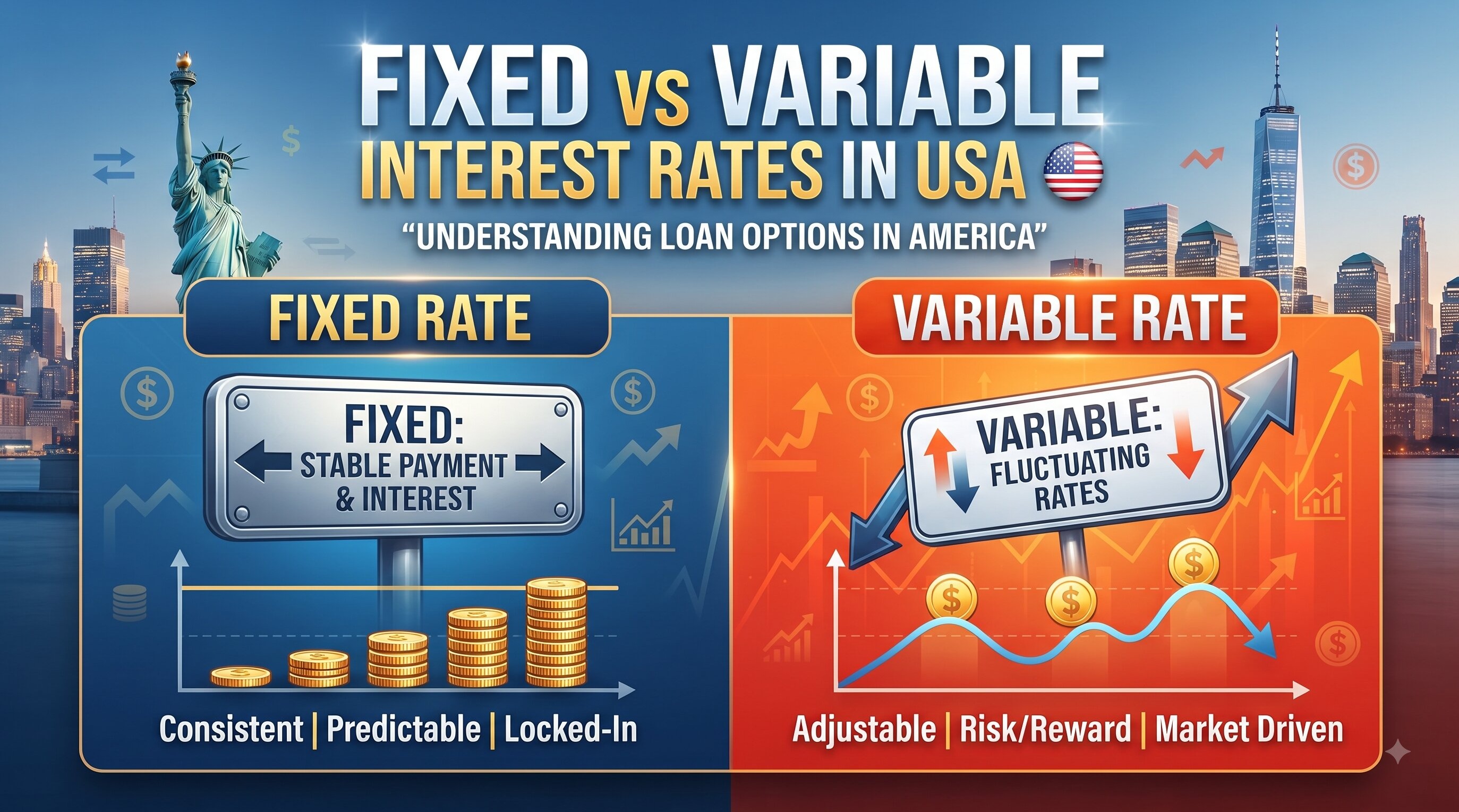
When comparing loans, one of the most important decisions you'll make is choosing between a fixed interest rate and a variable interest rate. While both determine how much you'll pay to borrow money, they work very differently and can have a significant impact on your monthly payments and the total cost of your loan.
Some borrowers prefer the stability of fixed rates, while others choose variable rates because they often start lower. Neither option is automatically better—the right choice depends on your financial situation, risk tolerance, and how long you plan to keep the loan.
In this guide, we'll explain fixed and variable interest rates in simple language, compare their advantages and disadvantages, and help you decide which option may be right for you.
What Is an Interest Rate?
An interest rate is the percentage a lender charges for allowing you to borrow money.
The interest rate affects:
- Your monthly payment
- The total interest you'll pay
- The overall cost of your loan
Even a small difference in interest rates can save—or cost—you thousands of dollars over the life of a loan.
If you're new to borrowing, start with How Interest Works on Loans:
https://statush.com/credit-score-debt/how-interest-works-on-loans
Fixed vs Variable Interest Rates at a Glance
| Feature | Fixed Interest Rate | Variable Interest Rate |
|---|---|---|
| Monthly Payment | Usually stays the same | May increase or decrease |
| Interest Rate | Locked for the loan term | Changes with market conditions |
| Budgeting | Easier | Less predictable |
| Initial Rate | Often slightly higher | Often starts lower |
| Financial Risk | Lower | Higher |
Understanding these differences helps you compare loan offers more effectively.
What Is a Fixed Interest Rate?
A fixed interest rate remains the same throughout the life of the loan.
That means:
- Your interest rate doesn't change.
- Your monthly payment usually stays the same.
- Budgeting becomes much easier.
Many borrowers choose fixed-rate loans because they offer stability and predictability.
Real-World Example
Emma takes out a five-year personal loan with a fixed interest rate.
Even if market interest rates increase over the next several years, Emma's monthly payment remains exactly the same.
She knows what she'll pay each month, making it easier to manage her household budget.
Advantages of Fixed Interest Rates
Fixed-rate loans offer several important benefits.
Predictable Monthly Payments
You'll know exactly how much you'll owe every month.
Easier Budgeting
Since payments don't change, long-term financial planning becomes simpler.
Protection Against Rising Rates
If market interest rates increase, your loan remains unaffected.
This stability is especially valuable during periods of economic uncertainty.
Disadvantages of Fixed Interest Rates
Fixed rates also have a few drawbacks.
- Initial interest rates may be slightly higher.
- You won't automatically benefit if market rates decline.
- Refinancing may be required to secure a lower rate later.
Despite these limitations, many borrowers appreciate the certainty fixed rates provide.
What Is a Variable Interest Rate?
A variable interest rate can change during the loan term.
The rate is usually tied to a financial benchmark or market index.
As market rates change:
- Your interest rate may increase.
- Your interest rate may decrease.
- Your monthly payment may change.
Because of this uncertainty, variable-rate loans involve more financial risk.
Real-World Example
Michael chooses a variable-rate student loan because it starts with a lower interest rate than a comparable fixed-rate loan.
For the first two years, his payments remain relatively low.
Later, market interest rates rise, causing his loan rate to increase. As a result, his monthly payments become higher than he originally expected.
While he saved money initially, the later increases made budgeting more difficult.
Advantages of Variable Interest Rates
Variable-rate loans may offer several benefits.
Lower Starting Rates
Many lenders offer lower introductory interest rates than fixed-rate loans.
Potential Savings
If market rates remain stable or decrease, borrowers may pay less interest over time.
Good for Short-Term Borrowing
Borrowers planning to repay their loans quickly may benefit if rates remain low during the repayment period.
Disadvantages of Variable Interest Rates
Variable rates also carry risks.
- Payments may increase unexpectedly.
- Long-term borrowing costs become harder to predict.
- Budgeting is more difficult.
- Rising interest rates can significantly increase total repayment costs.
Borrowers should understand these risks before choosing a variable-rate loan.
Which Loans Typically Use Fixed Rates?
Many common loans use fixed interest rates.
Examples include:
- Personal loans
- Most auto loans
- Many mortgages
- Federal student loans
Fixed rates are popular because borrowers value payment stability.
Learn more:
- How Personal Loans Work
https://statush.com/credit-score-debt/how-personal-loans-work - How Car Loans Work
https://statush.com/credit-score-debt/how-car-loans-work
Which Loans May Have Variable Rates?
Variable rates are more common with:
- Some private student loans
- Adjustable-rate mortgages (ARMs)
- Home equity lines of credit (HELOCs)
- Certain business loans
Borrowers should carefully review how and when the interest rate can change.
How to Choose Between Fixed and Variable Rates
The best choice depends on your financial goals.
A fixed rate may be a better option if you:
- Prefer predictable monthly payments
- Plan to keep the loan for many years
- Want protection from rising interest rates
- Follow a strict monthly budget
A variable rate may be worth considering if you:
- Expect to repay the loan quickly
- Can comfortably handle payment increases
- Believe market interest rates may remain stable or fall
- Qualify for a significantly lower starting rate
There's no universal answer—your financial situation should guide the decision.
Practical Tips Before Choosing
Before accepting any loan offer:
- Compare both fixed and variable options.
- Calculate the total repayment cost.
- Read how rate adjustments are determined.
- Understand how often rates can change.
- Consider your future income and financial stability.
- Borrow only what you truly need.
Spending a little extra time comparing offers can lead to significant long-term savings.
Common Mistakes to Avoid
Many borrowers focus only on the starting interest rate.
Avoid these common mistakes:
- Choosing a variable rate without understanding the risks.
- Ignoring how future rate increases affect payments.
- Looking only at monthly payments instead of total loan cost.
- Assuming today's low interest rates will last forever.
- Not comparing multiple lenders.
- Borrowing more than necessary.
Understanding the complete loan agreement is just as important as comparing interest rates.
Can You Switch Later?
In some cases, yes.
Borrowers may refinance an existing loan to switch from:
- Variable to fixed interest
- Fixed to variable interest
Whether refinancing makes sense depends on current interest rates, your credit profile, and any refinancing costs.
Learn more in How to Refinance a Loan:
https://statush.com/credit-score-debt/how-to-refinance-a-loan
Final Thoughts
Choosing between a fixed and variable interest rate is one of the most important decisions you'll make when borrowing money. Fixed rates provide stability and predictable payments, making them ideal for borrowers who value financial certainty. Variable rates may offer lower initial costs, but they also introduce uncertainty because payments can change over time.
Before signing any loan agreement, compare both options carefully, consider how long you'll keep the loan, and evaluate how much financial risk you're comfortable taking. A well-informed decision today can save you money and reduce financial stress throughout the life of your loan.
Related Articles
- How Interest Works on Loans
https://statush.com/credit-score-debt/how-interest-works-on-loans - Loan Amortization Explained
https://statush.com/credit-score-debt/loan-amortization-explained - How to Calculate Loan Payments
https://statush.com/credit-score-debt/how-to-calculate-loan-payments - How to Refinance a Loan
https://statush.com/credit-score-debt/how-to-refinance-a-loan - Best Strategies to Reduce Loan Interest
https://statush.com/credit-score-debt/best-strategies-to-reduce-loan-interest - Smart Borrowing Tips
https://statush.com/credit-score-debt/smart-borrowing-tips