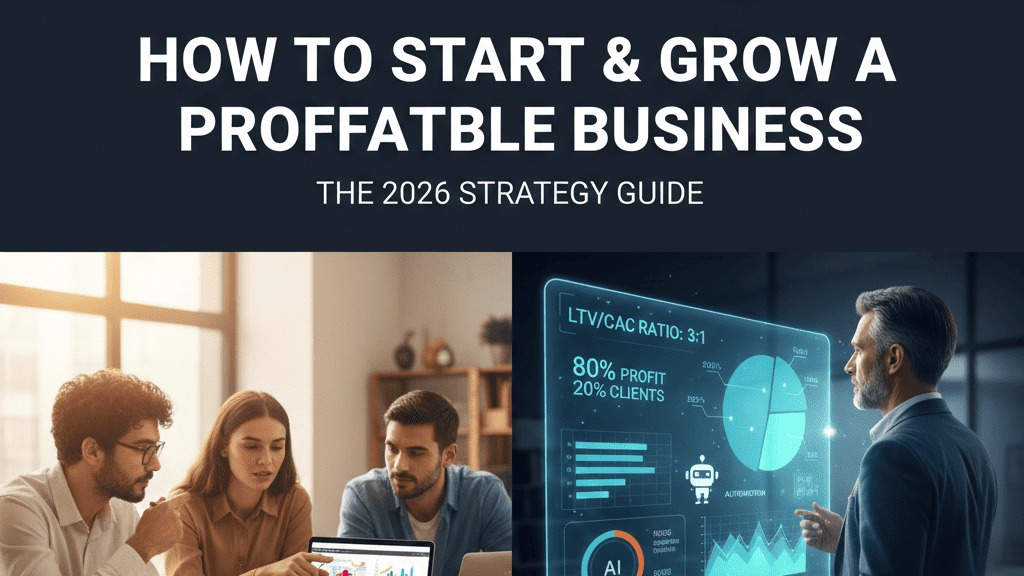
Starting a profitable business in 2026 is less about having a "perfect" idea and more about rapid execution and solving a specific pain point in an increasingly automated world.
Here is a comprehensive roadmap to taking a business from a mere concept to a scalable, profit-generating machine.
Phase 1: The Blueprint (Idea & Validation)
Profitability starts before you sell a single product. It begins with market fit.
- Identify a High-Value Problem: Don't just build what you like; build what people need. Look for "bleeding neck" problems—issues so urgent that customers are already spending money to fix them.
- The MVP (Minimum Viable Product): Avoid "feature creep." Launch the simplest version of your product that still delivers value. This allows you to test the market without over-investing capital.
- Validate with Pre-Sales: The ultimate validation isn't a "like" on social media; it’s a transaction. Use landing pages or pre-orders to see if people will actually open their wallets.
Phase 2: The Legal and Financial Foundation
To be profitable, you must be protected. Skipping these steps can lead to "expensive lessons" later.
- Structure for Growth: * LLC: Great for liability protection and "pass-through" taxation.
- C-Corp: Best if you plan to seek Venture Capital or go public.
- The "Profit First" Accounting Method: Most founders wait until the end of the month to see what’s left for profit. Instead, allocate a fixed percentage (e.g., 5-10%) to a profit account first, then manage expenses with what remains.
- Unit Economics: You must know your LTV (Lifetime Value of a customer) and CAC (Customer Acquisition Cost). A profitable business typically maintains an $LTV:CAC$ ratio of 3:1 or higher.
Phase 3: Building a Scalable Sales Engine
You don't have a business until you have a repeatable way to get customers.
1. The Marketing Funnel
A business grows by moving strangers through a logical journey:
- Top of Funnel (Awareness): Content marketing, SEO, and social media.
- Middle of Funnel (Consideration): Email newsletters, webinars, and case studies.
- Bottom of Funnel (Conversion): Sales calls, demos, and limited-time offers.
2. High-Margin Pricing
Profitability is often a pricing issue, not a volume issue.
- Value-Based Pricing: Instead of "Cost + 20%," price based on the result you provide. If your software saves a company $100,000, charging $10,000 is a bargain.
- Tiered Offers: Give customers a "Good, Better, Best" option to capture different budget levels.
Phase 4: Scaling and Operations
Growing a business is different from starting one. Scaling requires moving from "doing the work" to "building the system."
- Standard Operating Procedures (SOPs): Document every recurring task. If you can’t delegate it, you don't own a business; you own a job.
- The 80/20 Rule (Pareto Principle): In most businesses, 80% of profits come from 20% of customers. Identify your most profitable niche and double down on them while firing high-maintenance, low-margin clients.
- Leveraging AI and Automation: In 2026, profitability is tied to efficiency. Use AI for customer support (LLM-based bots), lead generation, and data analysis to keep your "headcount" low and "output" high.
Phase 5: Common Pitfalls to Avoid
- Cash Flow Blindness: You can be "profitable" on paper but go bankrupt because your cash is tied up in inventory or unpaid invoices.
- Hiring Too Fast: Every new employee increases your "burn rate." Hire only when the pain of not having that person is costing you more than their salary.
- Losing Focus: Don't chase "shiny objects." Master one product and one marketing channel before diversifying.