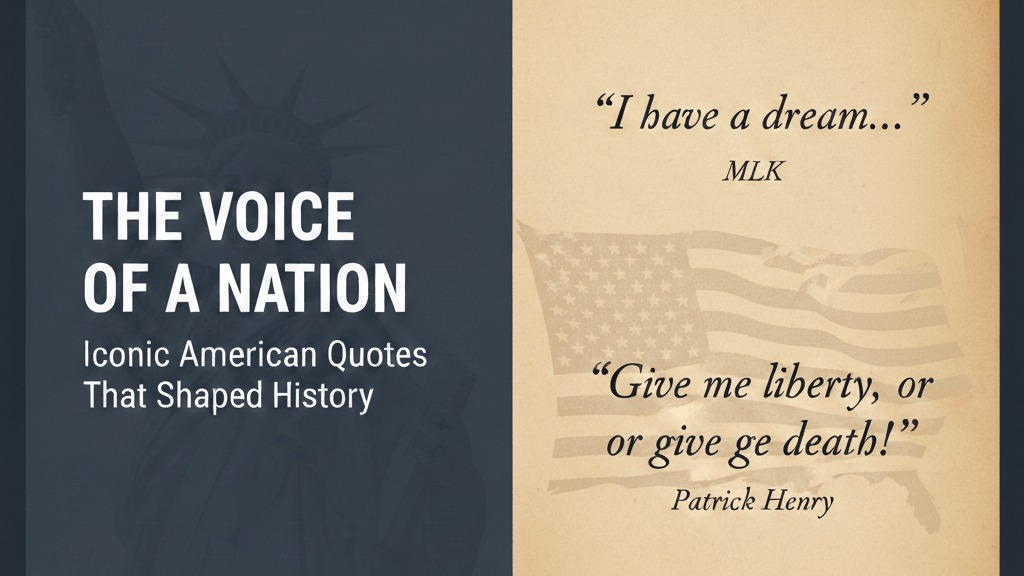
The history of the United States is more than just a timeline of dates and battles; it is a collection of powerful ideas captured in brief, unforgettable phrases. From the revolutionary cries of the 18th century to the calls for equality in the 20th, famous American quotes serve as the "cliffsnotes" of the national character.
The Power of Rhetoric
American identity is built on the belief that words have the power to change reality. When Patrick Henry declared, "Give me liberty, or give me death," he wasn't just making a dramatic statement—he was articulating a shift in mindset that turned colonists into revolutionaries. This tradition of "bold speech" became a hallmark of American leadership.
A Mirror to Progress
As the nation evolved, so did its most famous lines. The quotes we remember most are often those that challenged the status quo.
- The 1860s: Abraham Lincoln’s Gettysburg Address redefined the Civil War not just as a struggle for territory, but as a “new birth of freedom.”
- The 1960s: Dr. Martin Luther King Jr.’s "I Have a Dream" speech took the founding promises of 1776 and demanded they finally be applied to all citizens.
These quotes act as a moral compass, reminding the public of the country's ideals even when it fails to live up to them.
Why They Last
Why do phrases like JFK’s "Ask not what your country can do for you" still resonate today?
- Simplicity: They distill complex political philosophies into a single, digestible thought.
- Unity: They focus on shared responsibility and the collective "American Dream."
- Resilience: They often emerge during times of crisis (the Great Depression, World Wars, or Civil Rights), offering a sense of hope and direction.
Here are some of the most famous and impactful quotes categorized by their central themes.
🏛️ Foundations & Liberty
These quotes come from the era of the Founding Fathers and the struggle for independence.
- "Give me liberty, or give me death!" — Patrick Henry (1775)
- "We hold these truths to be self-evident, that all men are created equal..." — The Declaration of Independence (1776)
- "Where liberty dwells, there is my country." — Benjamin Franklin
- "The price of freedom is eternal vigilance." — Thomas Jefferson
🇺🇸 Leadership & Civic Duty
Presidents and leaders often used their platforms to remind citizens of their role in the democracy.
- "Ask not what your country can do for you — ask what you can do for your country." — John F. Kennedy (1961)
- "The only thing we have to fear is fear itself." — Franklin D. Roosevelt (1933)
- "Government of the people, by the people, for the people, shall not perish from the earth." — Abraham Lincoln (Gettysburg Address, 1863)
- "There is nothing wrong with America that cannot be cured by what is right with America." — Bill Clinton (1993)
💫 The American Dream & Identity
Quotes that capture the hope, diversity, and grit that define the American experience.
- "I have a dream that one day this nation will rise up and live out the true meaning of its creed..." — Martin Luther King Jr. (1963)
- "America is another name for opportunity." — Ralph Waldo Emerson
- "The essence of America... is an idea: That you can come from humble circumstances and do great things." — Condoleezza Rice
- "America is a tune. It must be sung together." — Gerald Stanley Lee
⚖️ Critical Patriotism & Reflection
True patriotism often involves a deep love for the country while pushing it to be better.
- "I love America more than any other country in the world and, exactly for this reason, I insist on the right to criticize her perpetually." — James Baldwin
- "Patriotism is supporting your country all the time, and your government when it deserves it." — Mark Twain
- "Well-behaved women seldom make history." — Laurel Thatcher Ulrich
Conclusion
To study American quotes is to study the heart of the people. They represent a culture that is constantly debating, defining, and refining what it means to be free. Whether etched in marble on a monument or shared in a classroom, these words remain the glue that binds the diverse American experience together.