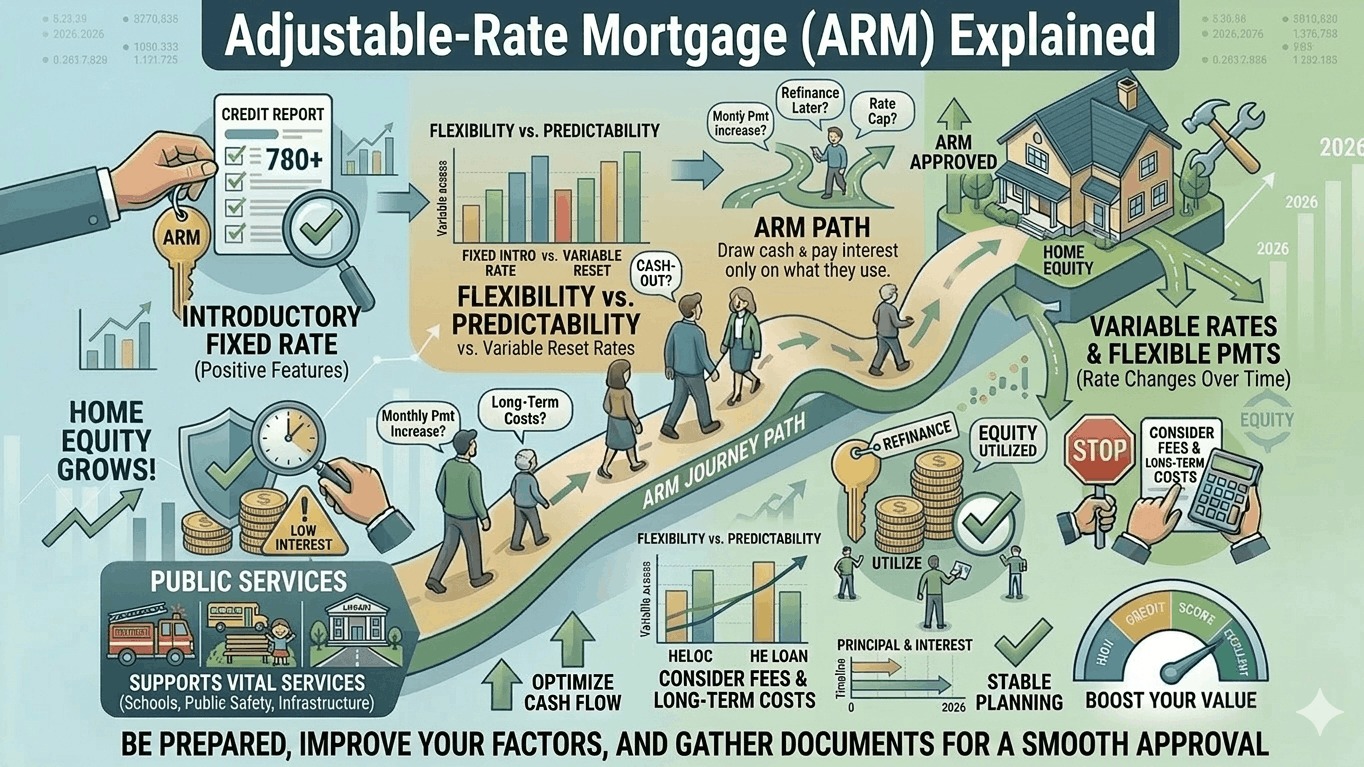
In the U.S. housing market, the Adjustable-Rate Mortgage (ARM) has seen a massive resurgence. As homebuyers look for ways to lower their monthly payments in a stabilized but higher-rate environment, ARMs offer a strategic entry point. Unlike the risky products of decades past, modern 2026 ARMs are highly regulated with built-in "caps" to protect consumers.
Understanding how an ARM works—and more importantly, how the "reset" works—is essential to deciding if this loan is a clever financial maneuver or a long-term risk for your household.
1. What is an Adjustable-Rate Mortgage?
An ARM is a home loan with an interest rate that changes periodically. This is in contrast to a Fixed-Rate Mortgage, where the rate remains the same for the life of the loan.
An ARM typically begins with a Fixed-Rate Period (teaser rate), during which the interest rate is lower than what you would get on a traditional 30-year fixed loan. After this period ends, the rate adjusts based on the performance of a specific financial index.
2. Anatomy of a 2026 ARM: The Numbers to Know
When you look at ARM disclosures in 2026, you will see a series of numbers (e.g., 5/6, 7/6, or 10/6). Here is what they mean:
- The First Number: The length of the fixed-rate period in years.
- The Second Number: How often the rate adjusts after the fixed period (in 2026, most loans adjust every 6 months, hence the "/6").
- The Index: Most 2026 ARMs are tied to the SOFR (Secured Overnight Financing Rate). When the SOFR goes up, your rate goes up.
The Margin: A fixed percentage (e.g., 2.5%) that the lender adds to the index to determine your new rate.
Calculation: Index (SOFR) + Margin = Your New Interest Rate.
3. The Safety Net: Understanding Rate Caps
Modern ARMs are equipped with caps to prevent your payment from skyrocketing. A common 2026 cap structure is 2/1/5:
- Initial Cap (2%): The maximum your rate can rise at the first adjustment.
- Subsequent Cap (1%): The maximum it can rise during any following adjustment period.
- Lifetime Cap (5%): The absolute maximum the rate can ever increase over the life of the loan.
4. When Does an ARM Make Sense?
In 2026, an ARM is a "strategic" loan. It is best suited for:
- The "Short-Term" Owner: If you plan to sell the home or move within 5–7 years, you can enjoy the lower initial rate and exit before the first adjustment.
- The Future Refinancer: Borrowers who believe interest rates will drop significantly in the next few years may take an ARM now and plan to refinance into a fixed-rate loan later.
- Rising Income Earners: Professionals who expect their salary to increase significantly can handle the potential of a higher payment in the future for the benefit of lower costs today.