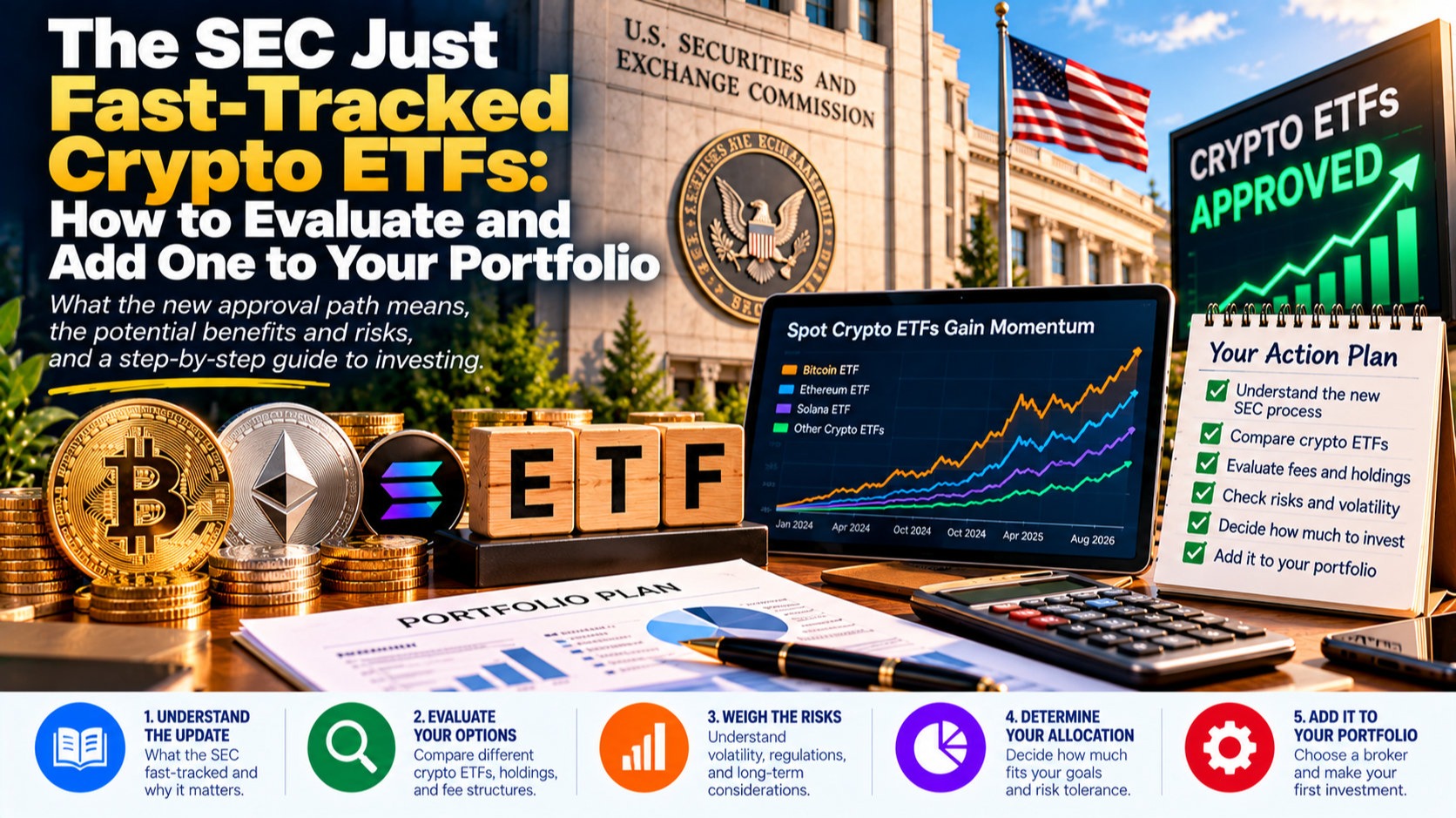
On September 17, 2026, the SEC voted to approve generic listing standards for exchange-traded products holding spot commodities, including digital assets - a change that lets qualifying crypto ETFs list on US exchanges without going through a separate, fund-by-fund 19b-4 rule-change process. The agency applied the new framework immediately: Grayscale's Digital Large Cap Fund, a multi-asset product holding bitcoin, ether, and smaller allocations to Solana, Cardano, and XRP, was approved and began trading on September 18. Less than two weeks later, on September 29, the SEC told issuers of proposed single-asset ETFs for Litecoin, XRP, Solana, Cardano, and Dogecoin to withdraw their pending 19b-4 filings and move straight to S-1 registration statements - the last procedural step before a fund can actually launch.
The practical effect is that approval timelines, which used to run as long as 240 days, can now be as short as 75 days. That means a wave of new crypto ETFs is likely to reach brokerage accounts over the next several months, on top of the spot bitcoin, ether, Solana, and XRP funds that already launched earlier in 2025 and 2026. If you've been curious about crypto exposure but didn't want to manage a wallet or a crypto exchange account, this guide walks through how to decide if a crypto ETF belongs in your portfolio, how to evaluate one before you buy, and how to actually place the trade - wherever in the world you're investing from.
What Changed and Why It Matters
Before this rule change, every new crypto ETF had to clear its own individual 19b-4 filing with the SEC, a process that involved public comment periods and could stretch close to eight months per fund. Generic listing standards remove that fund-by-fund review for products that meet pre-set criteria, putting crypto ETPs on a path closer to the one already used for commodity trusts like gold ETFs. For everyday investors, fewer procedural hurdles for issuers usually means more products, lower minimums to get started, and - eventually - more competition on fees.
| Before September 2026 | After the Rule Change |
|---|---|
| Up to 240 days per fund for SEC review | As little as 75 days for qualifying funds |
| Separate 19b-4 filing required for each new crypto ETF | Funds meeting generic standards skip the individual 19b-4 process |
| Single-asset filings (e.g., Litecoin, Dogecoin) faced open-ended review | Issuers told to withdraw 19b-4s and proceed via S-1 registration |
| Grayscale Digital Large Cap Fund: pending | Grayscale Digital Large Cap Fund: approved and trading as of Sept. 18, 2026 |
It's worth being clear about what this does and doesn't mean for international readers. The US is actually catching up to markets that have offered regulated crypto exposure for longer. Canada's Toronto Stock Exchange has listed spot bitcoin and ether ETFs since 2021, and issuers there have filed for products like XRP funds well ahead of comparable US approvals. In the UK, the FCA lifted its retail ban on crypto ETNs in 2025, opening London Stock Exchange-listed products from issuers such as 21Shares and BlackRock's iShares range to ordinary retail investors for the first time. Continental European investors have had access to crypto ETPs on exchanges like Deutsche Börse and Euronext since early 2025. Australian investors can already buy ASX-listed spot bitcoin and ether ETFs. If you're outside the US, the new SEC standards mainly mean more US-listed options and tighter competition - not your first chance at this asset class.
Crypto ETF vs. Buying Crypto Directly
A crypto ETF holds the underlying coins (or a basket of them) in custody and issues shares that trade on a regular stock exchange, through the same brokerage account you already use for stocks and index funds. That's the entire appeal: no separate exchange account, no seed phrase to protect, no self-custody wallet to lose access to. You get exposure to the price of bitcoin, ether, or a multi-asset basket, and the fund handles custody, security, and (for products like Grayscale's) the mechanics of holding several coins in one wrapper.
The trade-off is cost and control. ETFs charge an annual expense ratio - often in the 0.20% to 1.5% range for crypto products, noticeably higher than a typical S&P 500 index fund - and you never actually hold the underlying asset, so you can't move it, spend it, or stake it yourself (unless the fund specifically offers a staking share class, as some ether products now do). You're also still fully exposed to crypto's price swings; a wrapper doesn't reduce the volatility, it just changes how you access it.
How to Evaluate a Crypto ETF Before You Buy
- Check what it actually holds. A single-asset fund (bitcoin-only, ether-only) behaves very differently from a multi-asset fund like Grayscale's Digital Large Cap product, which spreads exposure across several coins with very different volatility and liquidity profiles.
- Compare expense ratios. Even a half-point difference in annual fees compounds meaningfully over a decade of holding, especially on a volatile asset where you're already taking on significant price risk.
- Look at assets under management and trading volume. A fund with thin daily volume can have wider bid-ask spreads, which quietly erodes returns every time you buy or sell.
- Understand the custody arrangement. Most issuers use a named third-party custodian (Coinbase Custody is common); know who it is and whether the fund discloses insurance or security audits.
- Read the tracking method. Some funds hold the coins directly (spot); others use futures contracts, which can diverge from the spot price over time due to contract roll costs.
- Check the tax treatment in your own country. US investors generally get a standard 1099 for an ETF, which is simpler than tracking individual crypto trades; UK, Canadian, and Australian investors should confirm how their own tax authority treats fund distributions versus direct crypto gains, since the rules differ by jurisdiction.
How to Add a Crypto ETF to Your Portfolio: Step by Step
If you've decided a small allocation makes sense for you, the process is close to buying any other ETF:
- Confirm your brokerage actually lists the fund - most major US, UK, and Canadian brokerages now carry the larger spot bitcoin and ether ETFs, but newer or smaller single-asset funds may take a few weeks to appear after launch.
- Decide on a position size before you place the order. Many advisors who are comfortable recommending any crypto exposure at all suggest capping it at low single digits of a total portfolio, given the asset class's volatility.
- Place a limit order rather than a market order, especially for newer or lower-volume funds, so you're not caught by a wide spread during a volatile trading session.
- Decide where it fits in your account structure - a tax-advantaged account (a US Roth IRA, a UK Stocks and Shares ISA, a Canadian TFSA, or an Australian super fund that permits it) shelters any gains from annual tax, where direct crypto trading often can't.
- Set a review schedule. Because these are volatile holdings, check your allocation against your target at least quarterly and rebalance if it's drifted significantly.
Who Should Consider This - and Who Shouldn't
A small crypto ETF allocation can make sense for an investor who already has an emergency fund, is contributing to retirement accounts, and wants exposure to digital assets without managing a separate exchange account or wallet. It's a reasonable building block for someone who understands they could lose a meaningful share of that allocation and is comfortable with that specific risk, sized appropriately.
It's a poor fit if you're using money you'll need within the next few years, if you don't already have other diversified holdings in place, or if you're drawn in mainly by a recent price run rather than a considered view on the asset class. Chasing the newest single-asset fund right after a wave of approval headlines is one of the more common ways investors overpay for volatile exposure.
Common Mistakes to Avoid
- Buying several overlapping single-asset funds instead of one diversified product, which just concentrates risk and adds unnecessary fees.
- Ignoring the expense ratio because the headline story is about the coin's price, not the fund's cost structure.
- Treating a multi-asset fund like Grayscale's Digital Large Cap product as "diversified" in the same sense as a stock index fund - it's still one highly correlated asset class, just split across several coins.
- Assuming every newly approved fund will be available at your brokerage or in your country immediately; US approval doesn't automatically mean UK, Canadian, or Australian listing on the same timeline.
- Skipping the custody and tracking-method research because the fund trades through a familiar brokerage app.
Key Numbers to Know
Keep these figures in mind as more funds launch over the coming months: the SEC's new review window tops out around 75 days versus the old 240-day ceiling; Grayscale's Digital Large Cap Fund became the first product approved under the new standard on September 18, 2026; and issuers of Litecoin, XRP, Solana, Cardano, and Dogecoin funds were instructed to withdraw their 19b-4s on September 29, 2026 and refile via S-1, which is typically the final step before a fund actually starts trading. Watch for S-1 effectiveness dates on any fund you're considering rather than acting on headline approval news alone - the two can be weeks or months apart.