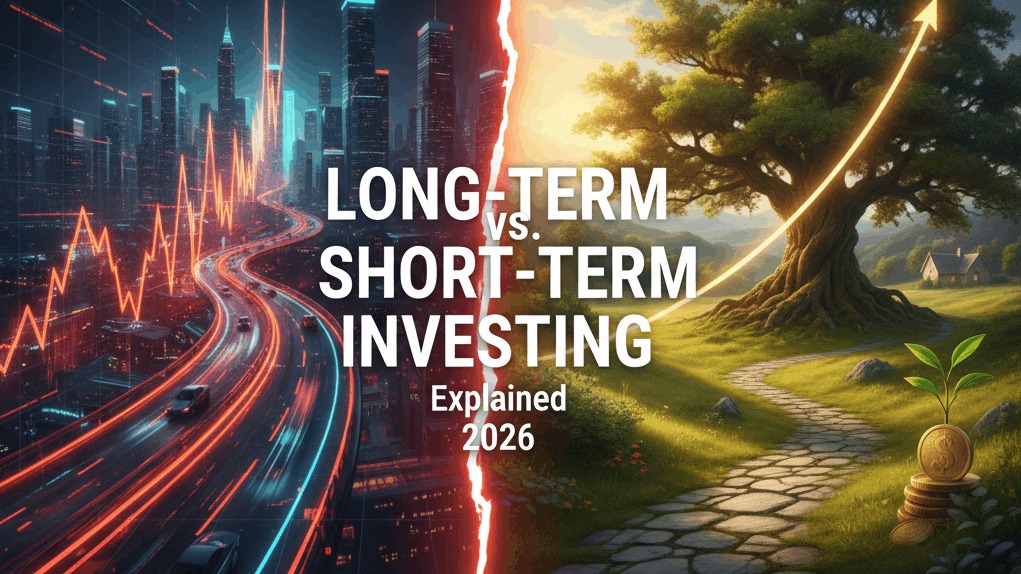
The world of investing often feels like a choice between two different personalities. On one side, you have the high-energy short-term trader, reacting to every headline and price flicker. On the other, you have the patient long-term investor, who checks their portfolio once a quarter and focuses on the horizon decades away.
In 2026, where AI-driven market shifts happen in milliseconds, understanding which camp you belong to is vital for your financial sanity—and your bank account.
Defining the Timeframes
Before we compare them, let’s define what these terms actually mean in today’s market:
- Short-Term Investing: Typically refers to any investment held for less than a year. This includes day trading (buying and selling within hours) or swing trading (holding for days or weeks). The goal is to profit from market volatility.
- Long-Term Investing: Generally refers to a "buy and hold" strategy with a timeframe of 5 to 30+ years. The goal is to benefit from the overall growth of the economy and the power of compounding.
The Pros and Cons of Short-Term Investing
Short-term investing is often fueled by the desire for "active income." In 2026, many people use AI-assisted tools to help spot trends.
The Upside:
- Liquidity: Your money isn't tied up for years; you can pull profits quickly.
- Market Agility: If a sector is crashing, you can exit immediately or even "short" the market to profit from the decline.
The Downside:
- The "Stress Tax": Constantly watching charts is emotionally exhausting.
- Transaction Costs: Frequent trading means more fees and higher taxes, which can eat up to 30-40% of your gains depending on your local laws.
- The Odds: Statistics consistently show that over 90% of retail day traders lose money over a 5-year period compared to the market average.
The Power of the Long-Term Approach
Long-term investing is about "Time in the market," not "Timing the market."
The Upside:
- Compounding: This is the process where your earnings earn more earnings. Over 20 years, compounding does more work for your wealth than your actual monthly contributions.
- Lower Taxes: Most tax codes reward "holders" with significantly lower tax rates on capital gains compared to "traders."
- Psychological Peace: You don't need to panic when the news says the market is down 2% today. You know that historically, the market recovers and reaches new highs over the long run.
The Downside:
- Lack of Access: Your money is often locked away (especially in retirement accounts) and may be subject to penalties if you need it for an emergency.
- Patience Required: It is boring. You won't have "exciting" stories about 500% gains in a week.
Which Strategy Should You Choose?
In 2026, the most successful investors often use a "Core and Satellite" approach.
- The Core (80-90%): This is your long-term "boring" money. It sits in diversified Index Funds and ETFs. It is your safety net and your retirement ticket.
- The Satellite (10-20%): This is your "play" money. You use this for short-term trades, individual stocks you’re passionate about, or speculative assets like crypto. If this money disappears, your lifestyle doesn't change.
10 Powerful Quotes on Long-Term vs. Short-Term Investing Explained
- “Short-term investing chases quick gains; long-term investing builds lasting wealth.”
- “The short term is driven by noise — the long term is driven by patience.”
- “Short-term investors watch the clock; long-term investors watch the calendar.”
- “In the short run, emotions move markets — in the long run, value does.”
- “Short-term investing seeks opportunity; long-term investing creates opportunity.”
- “Quick profits can be exciting, but compounding over time is transformative.”
- “The longer you stay invested, the less daily volatility matters.”
- “Short-term strategies react to trends; long-term strategies rely on time.”
- “Long-term investing rewards discipline, while short-term investing tests it.”
- “The difference between short-term and long-term investing isn’t just time — it’s mindset.”
Conclusion
Whether you choose the fast lane of short-term trading or the steady path of long-term holding depends on your goals, your temperament, and your stage in life. However, if your goal is sustainable, generational wealth, the long-term approach remains the undisputed champion.