If you are new to investing, you have probably seen the terms “index fund” and “ETF” mentioned constantly. At first glance, they seem almost identical because both can provide diversification, low fees, and passive investing opportunities.
That similarity often confuses beginners.
People naturally ask:
- Which one is better?
- Are ETFs safer?
- Are index funds better for long-term investing?
- Should beginners choose one over the other?
The truth is that index funds and ETFs share many similarities, but they also have important differences that affect flexibility, trading style, taxes, and investing behavior.
Understanding those differences can help you choose investments that match your financial goals and investing personality.
What Is an Index Fund?
An index fund is a type of mutual fund designed to track the performance of a market index.
For example:
- S&P 500 index
- Total stock market index
- International market indexes
Instead of trying to outperform the market, index funds simply aim to mirror the performance of the index they track.
That passive strategy is one reason index funds often have lower fees compared to actively managed funds.
How Index Funds Work
An S&P 500 index fund buys shares of companies included in the S&P 500.
So when the index rises or falls, the fund generally follows similar performance.
This gives investors instant diversification because they own small portions of many companies at once.
For beginners, this approach is often much simpler than researching individual stocks.
If you are still learning about market investing, you may also enjoy reading How to Invest in the S&P 500.
What Is an ETF?
ETF stands for Exchange-Traded Fund.
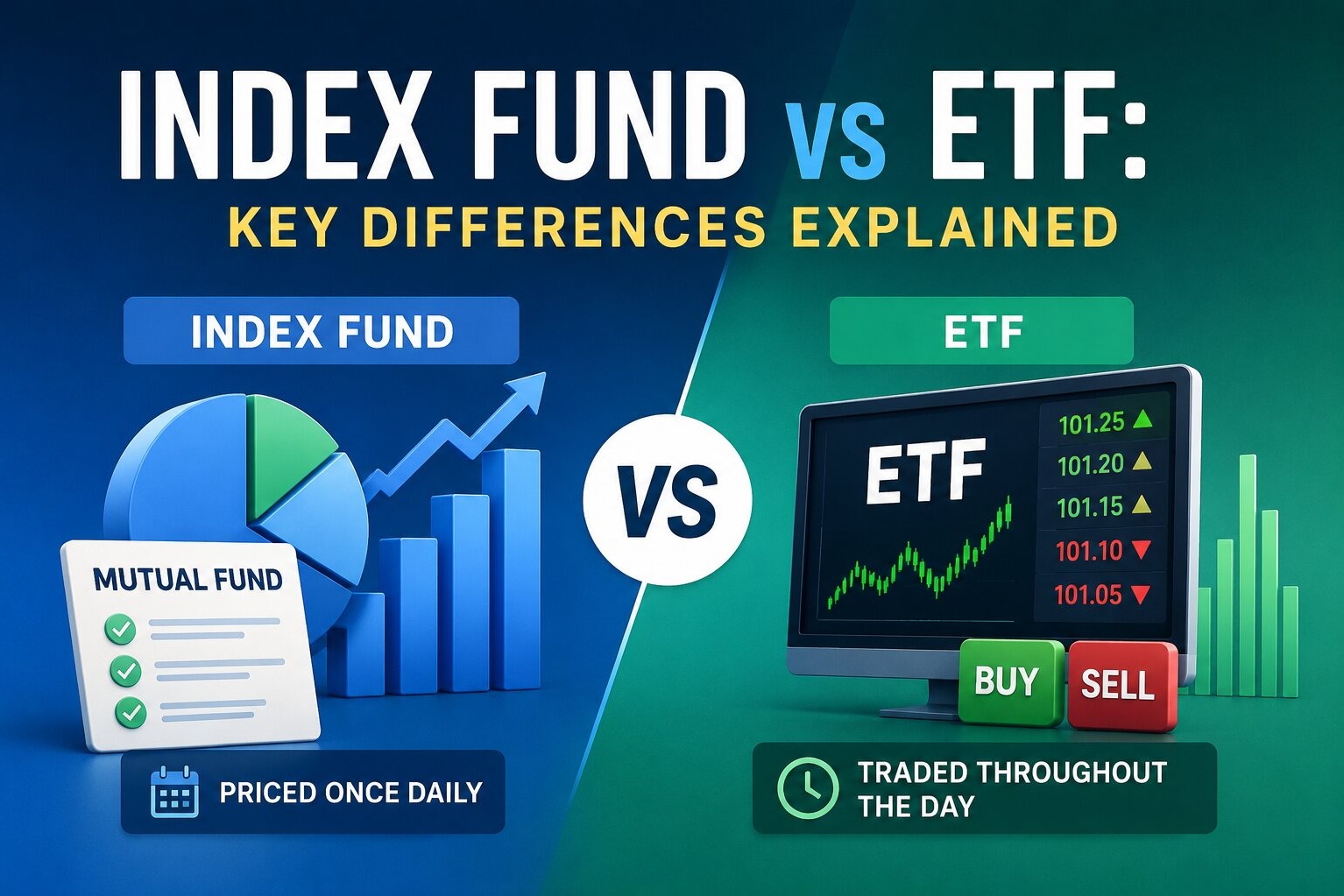
Like index funds, many ETFs also track market indexes. However, ETFs trade on stock exchanges throughout the trading day just like regular stocks.
That is one of the biggest differences.
Examples include:
- S&P 500 ETFs
- Bond ETFs
- Dividend ETFs
- Sector ETFs
Many ETFs are also passively managed and designed for long-term investing.
How ETFs Work
When you buy an ETF:
- You purchase shares through a brokerage account
- ETF prices fluctuate throughout the trading day
- You can buy or sell at market prices anytime markets are open
This flexibility appeals to many investors.
Main Similarities Between Index Funds and ETFs
Honestly, index funds and ETFs are more alike than different in many cases.
Both often provide:
- Diversification
- Low fees
- Passive investing
- Long-term growth potential
- Broad market exposure
Both are widely used by:
- Retirement investors
- Beginner investors
- Passive income investors
- Long-term wealth builders
This is why many people successfully use either option.
Key Differences Between Index Funds and ETFs
Now let’s look at the differences that actually matter.
Trading Flexibility
This is one of the clearest distinctions.
| Feature | Index Fund | ETF |
|---|---|---|
| Trades during market hours | No | Yes |
| Price updates | Once daily | Constantly |
| Can place limit orders | No | Yes |
| Can buy like a stock | No | Yes |
Index funds process trades after market close using the fund’s end-of-day net asset value.
ETFs trade throughout the day just like stocks.
For long-term investors, this difference may not matter much. But active traders often prefer ETFs for flexibility.
Minimum Investment Requirements
Some index funds require minimum investments.
For example:
- $500
- $1,000
- $3,000
ETFs usually allow investors to buy as little as one share.
Some brokerages even offer fractional ETF investing, making ETFs highly accessible for beginners with smaller budgets.
If you are still selecting an account platform, read Best Investment Accounts for Beginners.
Expense Ratios and Fees
Both ETFs and index funds are known for low costs compared to actively managed funds.
However, ETFs sometimes have slightly lower expense ratios.
Example Comparison
| Investment Type | Average Expense Ratio |
|---|---|
| Active Mutual Fund | Higher |
| Index Fund | Lower |
| ETF | Often very low |
Even small fee differences matter over decades because fees reduce compounding growth.
You may also want to read Tax-Efficient Investing Strategies to better understand long-term cost efficiency.
Tax Efficiency
ETFs are often considered more tax-efficient than traditional index mutual funds.
Why?
Because ETFs typically generate fewer taxable capital gains distributions.
This may not matter inside retirement accounts, but it can matter in taxable brokerage accounts.
Long-term investors who prioritize tax efficiency often pay close attention to this difference.
Automatic Investing
Index funds often make automatic investing easier.
Many platforms allow:
- Automatic monthly contributions
- Scheduled purchases
- Retirement automation
This is extremely useful for disciplined long-term investing.
While some brokerages now support recurring ETF purchases, index mutual funds traditionally handled automation more smoothly.
Honestly, automation is underrated in investing. It removes emotion and builds consistency.
If you are interested in long-term automated investing, you may also enjoy How to Create a Passive Investment Portfolio.
Liquidity and Trading Strategies
ETFs offer more flexibility for advanced investing strategies, including:
- Intraday trading
- Limit orders
- Stop-loss orders
- Options trading
Index funds are simpler and designed more for steady long-term investing.
For beginners, simplicity is usually a positive thing rather than a limitation.
Which Is Better for Beginners?
There is no universal answer.
Both can work extremely well.
Index Funds May Be Better If You:
- Prefer simplicity
- Want automatic investing
- Focus on retirement investing
- Avoid active trading temptation
ETFs May Be Better If You:
- Want flexibility
- Prefer lower minimum investments
- Use brokerage accounts frequently
- Want real-time trading access
In reality, many investors eventually own both.
Long-Term Investing Matters More Than Structure
A common beginner mistake is overthinking small differences while ignoring bigger investing habits.
The bigger factors usually include:
- Consistency
- Diversification
- Patience
- Low fees
- Emotional discipline
An investor consistently investing into diversified ETFs for 25 years will likely do far better than someone constantly trading individual stocks emotionally.
Likewise, someone steadily investing in index funds can build substantial long-term wealth.
This is why long-term strategy matters more than choosing the “perfect” investment vehicle.
You can explore this topic further in How to Build a Long-Term Investment Strategy.
Common Beginner Mistakes
Chasing Trends
Some investors constantly jump between popular ETFs based on social media hype.
That usually creates unnecessary risk and emotional investing.
Ignoring Diversification
Buying a single sector ETF is not the same as owning a diversified broad-market fund.
For example:
- Technology ETFs can become highly volatile
- Broad-market index funds reduce concentration risk
Read more here:
Portfolio Diversification Strategies
Trading Too Frequently
ETFs can tempt beginners into excessive trading because they trade like stocks.
Long-term investing generally rewards patience more than constant activity.
You may also benefit from reading Passive vs Active Investing Strategies.
Real-World Example
Imagine two investors:
Investor A
- Invests monthly into an S&P 500 index fund
- Never checks markets obsessively
- Holds investments for 20 years
Investor B
- Constantly buys trending ETFs
- Tries to time the market
- Panic-sells during downturns
Even if Investor B occasionally picks winning investments, Investor A often ends up with better long-term results simply because consistency beats emotional decision-making.
This happens more often than people realize.
Final Thoughts
Index funds and ETFs are both excellent tools for long-term investing.
Both offer:
- Diversification
- Lower fees
- Passive investing opportunities
- Broad market exposure
The right choice depends mostly on your investing style and personal preferences.
Index funds may appeal more to investors who value simplicity and automation. ETFs may work better for people who want flexibility and lower entry requirements.
But in many ways, the most important decision is not choosing between an ETF and an index fund.
The most important decision is actually starting, staying invested consistently, and maintaining discipline through market ups and downs.