Every investor wants strong returns, but nobody enjoys losing money.
That’s the basic reality of investing.
The problem is that risk and reward usually go together. Investments with higher potential returns often come with greater uncertainty, volatility, and emotional stress.
But reducing investment risk does not mean avoiding investing altogether. In fact, trying to avoid all risk can sometimes become its own financial mistake because inflation slowly erodes the value of idle cash over time.
The real goal is learning how to manage risk intelligently.
Smart investors focus less on eliminating risk completely and more on controlling unnecessary risks while improving their chances of long-term success.
What Is Investment Risk?
Investment risk refers to the possibility that an investment may lose value or fail to deliver expected returns.
Risk can come from many different sources:
- Economic recessions
- Market crashes
- Inflation
- Company failures
- Interest rate changes
- Political instability
- Poor investment decisions
Some risks are unavoidable. Others can be reduced significantly with proper strategy and discipline.
Why Risk Management Matters
One major investment loss can take years to recover from.
For example:
- Losing 10% requires an 11% gain to recover
- Losing 50% requires a 100% gain to break even
That’s why protecting capital matters so much.
Required Recovery Gain = Loss / 1-Loss
This mathematical reality explains why experienced investors spend enormous effort managing downside risk.
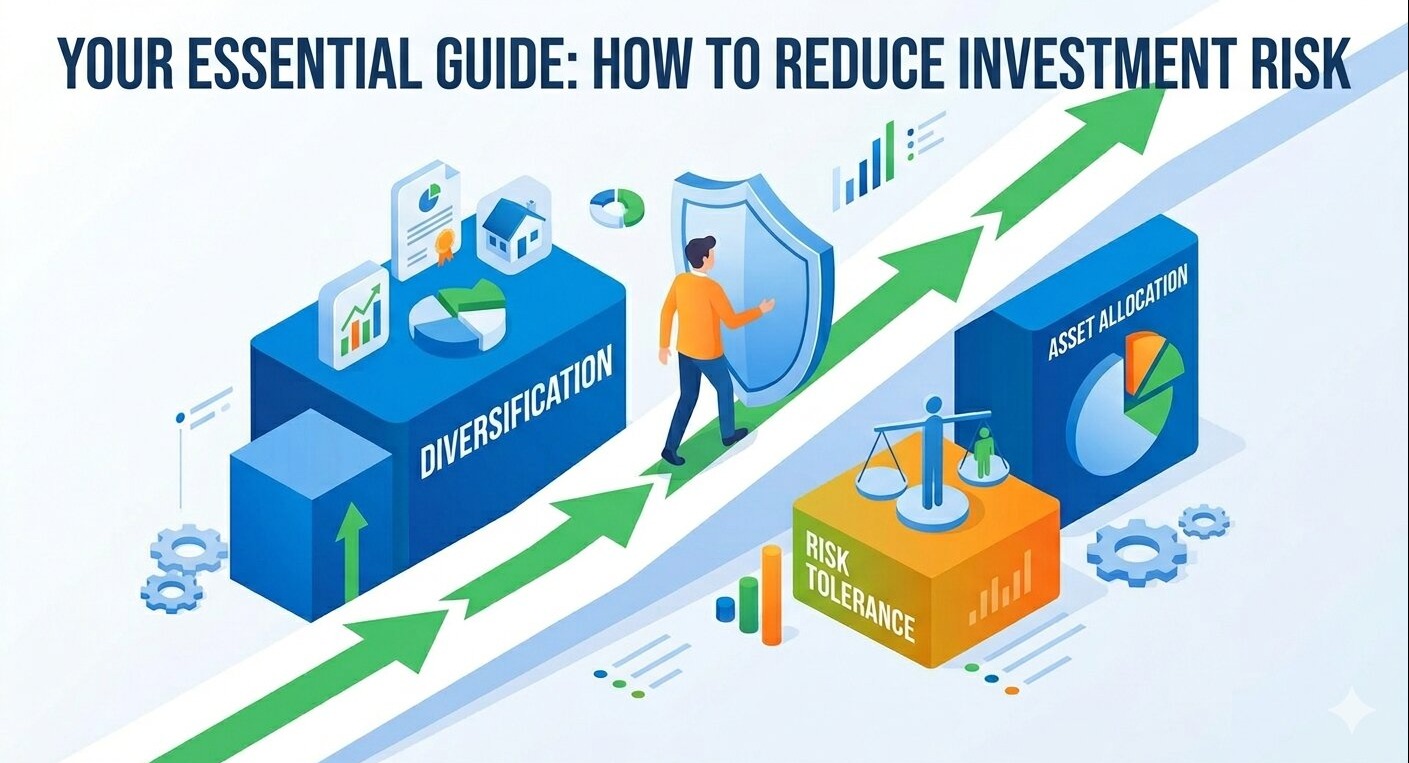
Diversification: The Most Important Risk Reduction Tool
Diversification simply means spreading investments across different assets instead of relying too heavily on one investment.
It’s one of the oldest and most effective investing principles.
The idea is straightforward:
- If one investment performs poorly
- Others may perform better and offset losses
Simple Diversification Example
| Poor Diversification | Better Diversification |
|---|---|
| 100% in one stock | Stocks, bonds, ETFs, cash |
| One industry only | Multiple industries |
| One country only | Global exposure |
Diversification will not eliminate losses completely, but it can reduce the severity of portfolio swings.
Avoid Putting Too Much Money Into One Stock
Many beginners become emotionally attached to a single company.
Maybe they love the brand, believe strongly in the business, or saw huge gains recently.
But concentrating too heavily in one stock creates major risk.
Even great companies can face:
- Lawsuits
- Competition
- Economic downturns
- Leadership problems
- Regulatory pressure
A diversified portfolio protects investors from a single mistake becoming financially devastating.
Asset Allocation Matters
Asset allocation refers to how investments are divided among different asset classes.
Common asset classes include:
- Stocks
- Bonds
- Cash
- Real estate
- Commodities
Different asset classes behave differently during market conditions.
For example:
- Stocks often provide higher long-term growth
- Bonds may offer stability during market declines
- Cash provides liquidity and lower volatility
Balancing these assets helps reduce overall portfolio risk.
You can learn more about balancing portfolios in Investment Portfolio Allocation by Age.
Invest for the Long Term
Short-term markets can behave irrationally.
Prices often swing based on:
- Fear
- Hype
- News headlines
- Interest rates
- Economic uncertainty
But over longer periods, quality businesses tend to reflect actual financial performance more accurately.
Long-term investing helps reduce:
- Emotional trading
- Reactionary decisions
- Short-term volatility stress
Historically, investors with longer time horizons have generally experienced lower risk compared to constant short-term trading.
Understand What You Invest In
One of the simplest ways to reduce risk is surprisingly overlooked:
Do not invest in things you do not understand.
Many investors buy stocks, cryptocurrencies, or speculative assets simply because:
- Social media promoted them
- Friends recommended them
- Prices were rising rapidly
That approach often ends badly.
Before investing, understand:
- How the business makes money
- Industry risks
- Debt levels
- Growth prospects
- Competitive advantages
This connects closely with concepts discussed in How to Evaluate Company Financial Statements.
Avoid Emotional Investing
Emotions are one of the biggest investment risks.
Fear and greed frequently push investors into bad decisions.
Common Emotional Mistakes
| Emotion | Typical Mistake |
|---|---|
| Fear | Selling during market crashes |
| Greed | Chasing speculative bubbles |
| Excitement | Ignoring valuation risks |
| Panic | Abandoning long-term plans |
Many investors buy high during excitement and sell low during panic.
Ironically, this behavior creates losses even when investing in good assets.
Dollar-Cost Averaging Can Reduce Timing Risk
Trying to perfectly time the market is extremely difficult.
Dollar-cost averaging helps reduce timing risk by investing fixed amounts regularly over time.
For example:
- Investing monthly regardless of market conditions
- Buying during both market highs and lows
This strategy smooths purchase prices and reduces emotional decision-making.
It’s especially useful for long-term retirement or passive investing plans.
Keep an Emergency Fund
This may not sound like investing advice, but it matters enormously.
Investors without emergency savings often panic-sell investments during financial emergencies.
A cash reserve provides flexibility during:
- Job loss
- Medical expenses
- Economic downturns
That stability reduces pressure to sell investments at bad times.
Pay Attention to Valuation
Even excellent companies can become risky investments if purchased at unrealistic prices.
Overpaying increases downside risk.
This is why valuation metrics matter.
You can better understand valuation concepts in Price-to-Earnings Ratio Explained.
Many market crashes happen because investors become overly optimistic and push valuations too high.
Limit High-Risk Speculation
Speculative investments can be exciting, but they should usually represent only a small portion of a portfolio.
Examples include:
- Meme stocks
- Highly leveraged trades
- Extremely volatile cryptocurrencies
- Unproven startups
Some speculation is fine for investors comfortable with higher risk, but relying heavily on speculation can create serious financial damage.
Rebalance Your Portfolio Periodically
Over time, certain investments grow faster than others.
This can accidentally create excessive concentration.
For example:
- Stocks rise sharply
- Portfolio becomes too stock-heavy
- Risk exposure increases
Rebalancing restores your intended allocation.
Many investors review portfolios:
- Quarterly
- Semiannually
- Annually
Bonds Can Help Reduce Volatility
Bonds often behave differently from stocks during economic uncertainty.
While bonds usually offer lower long-term returns, they can provide:
- Income
- Stability
- Lower volatility
This is one reason many conservative investors include bonds in diversified portfolios.
You can explore fixed-income investing further in How to Invest in Bonds for Beginners.
Beware of Following Trends Blindly
Financial markets constantly create “hot trends.”
At different times, investors become obsessed with:
- AI stocks
- Real estate booms
- Tech bubbles
- Meme stocks
- Commodities
- Crypto surges
Some trends eventually succeed. Others collapse dramatically.
The problem is not necessarily the trend itself — it’s blindly following excitement without proper analysis.
Risk Tolerance Is Personal
Not every investor handles risk the same way.
A young investor with decades before retirement may tolerate more volatility than someone relying on investments for current income.
Your ideal strategy depends on:
- Age
- Income stability
- Financial goals
- Personality
- Time horizon
There is no universal perfect portfolio.
Real-World Example of Risk Reduction
Imagine two investors.
Investor A
- Invests everything into one speculative stock
- Trades emotionally
- Uses borrowed money
- Chases trends constantly
Investor B
- Diversifies broadly
- Invests consistently
- Thinks long term
- Maintains balanced allocation
Investor A might occasionally experience explosive gains, but also faces much higher chances of devastating losses.
Investor B may grow wealth more steadily with lower overall stress and risk.
Over long periods, consistency often wins.
Practical Risk Reduction Checklist
| Strategy | Purpose |
|---|---|
| Diversification | Reduce concentration risk |
| Long-term investing | Reduce emotional decisions |
| Asset allocation | Balance risk and stability |
| Emergency savings | Avoid forced selling |
| Portfolio rebalancing | Maintain target risk levels |
| Financial research | Avoid poor investments |
Final Thoughts
Investment risk can never be eliminated completely.
Markets will always experience uncertainty, volatility, and occasional downturns. That’s simply part of investing.
But investors can dramatically reduce unnecessary risks through smart habits:
- Diversification
- Patience
- Discipline
- Research
- Proper asset allocation
The goal is not chasing perfect returns. The goal is building a strategy strong enough to survive difficult periods while continuing to grow over time.
And honestly, that mindset shift changes investing completely. Instead of constantly trying to predict the next market move, you start focusing on building a portfolio capable of handling uncertainty — which is usually a far more sustainable approach anyway.