A lot of people want to invest, but they don’t want investing to become a second full-time job.
They don’t want to spend hours:
- Analyzing charts
- Watching stock prices daily
- Predicting economic trends
- Constantly buying and selling investments
That’s exactly why passive investing became so popular.
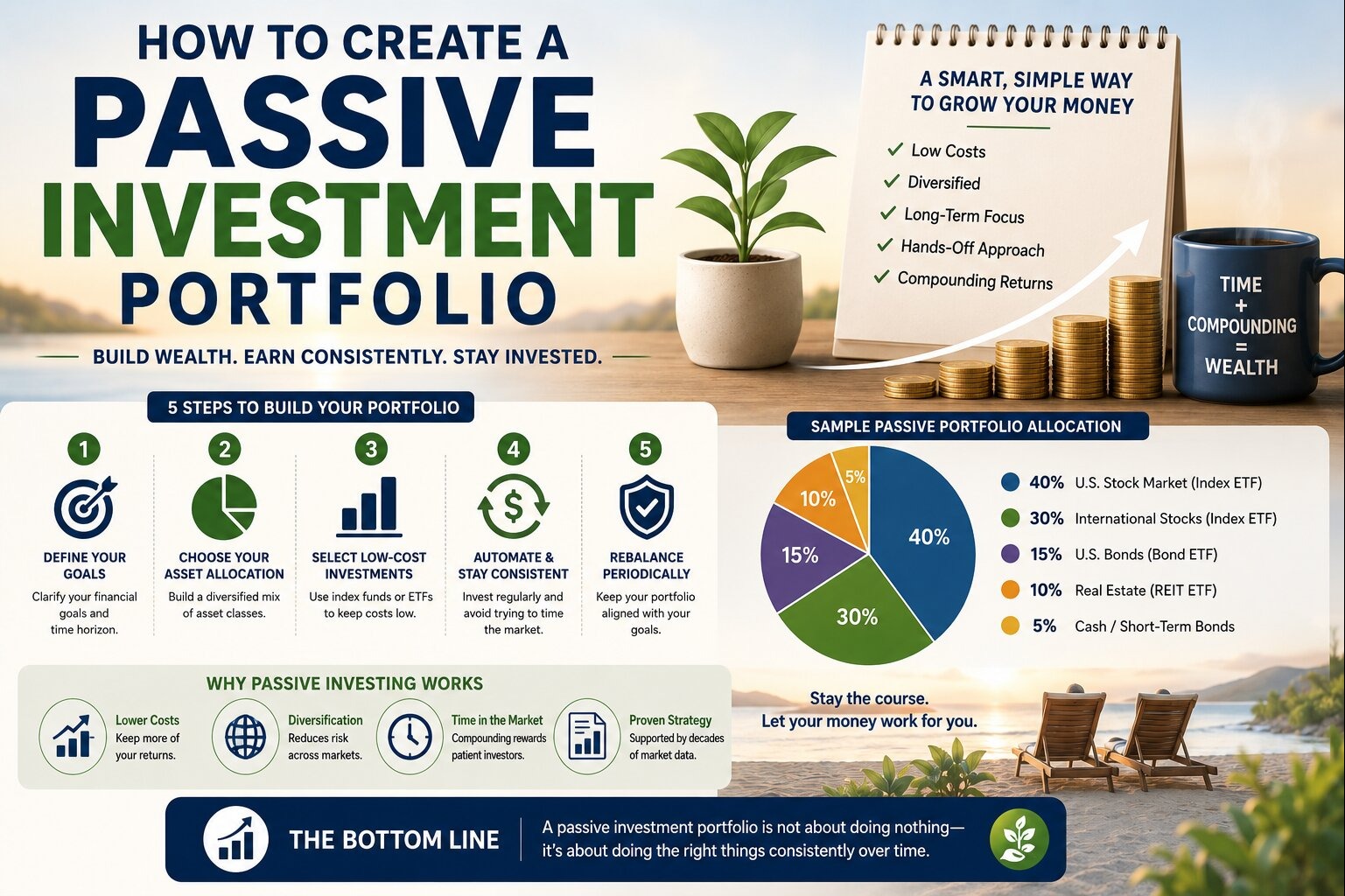
A passive investment portfolio is designed to grow steadily over time with minimal ongoing management. Instead of trying to outperform the market through constant activity, passive investors focus on:
- Diversification
- Consistency
- Long-term growth
- Low costs
- Patience
And honestly, one of the most surprising things about investing is that simpler strategies often outperform more complicated ones over long periods — especially after fees, taxes, and emotional mistakes are considered.
What Is a Passive Investment Portfolio?
A passive investment portfolio is a collection of investments designed to track overall market performance rather than actively trying to beat it.
Passive portfolios typically rely heavily on:
- Index funds
- ETFs
- Broad market diversification
The goal is not to predict which stocks will outperform next year.
The goal is building long-term wealth efficiently and consistently.
Why Passive Investing Works
Passive investing benefits from several powerful advantages.
Lower Costs
Passive funds usually charge lower fees because they simply track indexes rather than paying large research teams to actively manage investments.
Lower costs matter enormously over decades.
Even small fee differences compound significantly over time.
Diversification
Most passive index funds hold large numbers of companies.
For example:
- A total market ETF may hold hundreds or thousands of stocks
This reduces company-specific risk.
Reduced Emotional Investing
Passive investing discourages:
- Panic selling
- Market timing
- Chasing trends
- Emotional reactions
This often improves long-term investor behavior.
Tax Efficiency
Passive investing generally creates:
- Fewer trades
- Lower turnover
- Fewer taxable events
This helps improve after-tax returns.
You can learn more in Tax-Efficient Investing Strategies.
Core Components of a Passive Portfolio
A passive portfolio usually includes a mix of major asset classes.
| Asset Class | Purpose |
|---|---|
| Stocks | Long-term growth |
| Bonds | Stability and income |
| Cash | Liquidity and emergencies |
| International investments | Geographic diversification |
The exact mix depends on:
- Age
- Risk tolerance
- Financial goals
- Time horizon
Step 1: Determine Your Asset Allocation
Asset allocation is the foundation of portfolio construction.
This means deciding how much to invest in:
- Stocks
- Bonds
- Cash
Generally:
- Younger investors often hold more stocks
- Older investors may increase bond exposure gradually
You can explore this more deeply in Investment Portfolio Allocation by Age.
Simple Example Allocation
| Investor Type | Stocks | Bonds | Cash |
|---|---|---|---|
| Aggressive | 90% | 10% | Minimal |
| Moderate | 70% | 25% | 5% |
| Conservative | 50% | 40% | 10% |
There is no perfect allocation for everyone.
Step 2: Choose Broad Index Funds or ETFs
Passive investors commonly use:
- Total stock market funds
- S&P 500 index funds
- International index funds
- Bond index funds
These funds provide:
- Instant diversification
- Simplicity
- Low fees
Instead of trying to pick winning stocks individually, investors buy broad exposure to the overall market.
Step 3: Keep Costs Low
Investment fees reduce long-term returns.
For example:
- A 1.5% annual fee may seem small
- But over decades it can significantly reduce wealth accumulation
Passive investors usually prioritize:
- Low expense ratios
- Minimal trading costs
- Efficient fund structures
Keeping costs low is one of the easiest ways to improve long-term returns.
Step 4: Invest Consistently
Consistency matters more than perfect timing.
Many passive investors use automatic monthly investing.
This strategy helps:
- Build discipline
- Reduce emotional investing
- Smooth market fluctuations
This is commonly called dollar-cost averaging.
Why Regular Investing Helps
| Benefit | Why It Matters |
|---|---|
| Reduces timing pressure | No need to predict markets |
| Builds habits | Encourages discipline |
| Reduces emotional reactions | Less panic investing |
| Supports compounding | Long-term growth improves |
Step 5: Reinvest Dividends
Many passive investors automatically reinvest dividends.
This means:
- Dividend payments purchase additional shares
- Compounding accelerates over time
Reinvestment can significantly increase long-term portfolio growth.
You can learn more about dividend investing in Dividend Payout Ratio Explained.
Step 6: Rebalance Periodically
Over time, investments grow at different rates.
For example:
- Stocks perform strongly
- Portfolio becomes too stock-heavy
- Risk increases unintentionally
Rebalancing restores your intended allocation.
Example
Target allocation:
- 80% stocks
- 20% bonds
After strong stock growth:
- Stocks rise to 88%
Rebalancing may involve:
- Selling some stock holdings
- Buying more bonds
This helps maintain consistent risk levels.
Why Passive Portfolios Often Beat Active Investors
Many active investors struggle because of:
- Emotional trading
- High fees
- Excessive taxes
- Poor timing decisions
Passive investing removes many of these problems.
Historically, many actively managed funds have failed to outperform broad market indexes consistently after fees.
This is one reason passive investing became so dominant globally.
You can explore broader comparisons in Passive vs Active Investing Strategies.
Common Passive Portfolio Mistakes
| Mistake | Potential Problem |
|---|---|
| Constantly changing strategy | Emotional investing |
| Overcomplicating the portfolio | Difficult management |
| Ignoring diversification | Concentration risk |
| Chasing market trends | Poor timing |
| Panic selling during crashes | Locking in losses |
The biggest challenge with passive investing is often psychological, not technical.
Real-World Example
Imagine two investors.
Investor A
- Trades frequently
- Watches markets daily
- Chases trending stocks
- Reacts emotionally to headlines
Investor B
- Invests in diversified index funds
- Contributes monthly
- Rebalances occasionally
- Thinks long term
Investor A may occasionally outperform temporarily, but Investor B often experiences:
- Lower stress
- Better consistency
- Lower fees
- Fewer emotional mistakes
Over long periods, that consistency can become very powerful.
Passive Investing During Market Crashes
This is where discipline matters most.
Passive investors still experience market declines because they own the market itself.
But historically:
- Markets recovered from recessions
- Diversified portfolios rebounded over time
- Long-term investors benefited from staying invested
Selling during panic often causes more damage than the downturn itself.
This connects closely with principles discussed in How to Reduce Investment Risk.
Passive Investing Is Not “Doing Nothing”
Some people misunderstand passive investing.
Passive investing still requires:
- Planning
- Asset allocation
- Rebalancing
- Discipline
- Long-term thinking
The difference is that decisions are made systematically rather than emotionally reacting to daily market movements.
Who Benefits Most From Passive Investing?
Passive investing works especially well for:
- Beginners
- Busy professionals
- Retirement investors
- Long-term wealth builders
- Investors who dislike constant market monitoring
It’s designed for sustainability rather than excitement.
Practical Tips for Building a Passive Portfolio
Keep It Simple
Complex portfolios are not automatically better.
Automate Contributions
Automatic investing builds consistency.
Focus on Long-Term Goals
Short-term market noise matters less over decades.
Ignore Most Market Headlines
Financial media often amplifies short-term fear and excitement.
Stay Patient
Compounding takes time.
And that’s probably the hardest part psychologically for many investors.
Final Thoughts
Creating a passive investment portfolio is really about building a system rather than constantly making predictions.
A strong passive portfolio emphasizes:
- Diversification
- Low costs
- Consistency
- Long-term discipline
- Emotional control
It may not feel exciting every day, but over long periods, passive investing has helped many investors build meaningful wealth with less stress and fewer costly mistakes.
And honestly, that’s one reason passive investing continues growing in popularity. Many people eventually realize they would rather spend less time trying to outsmart the market and more time simply letting disciplined investing work steadily in the background.