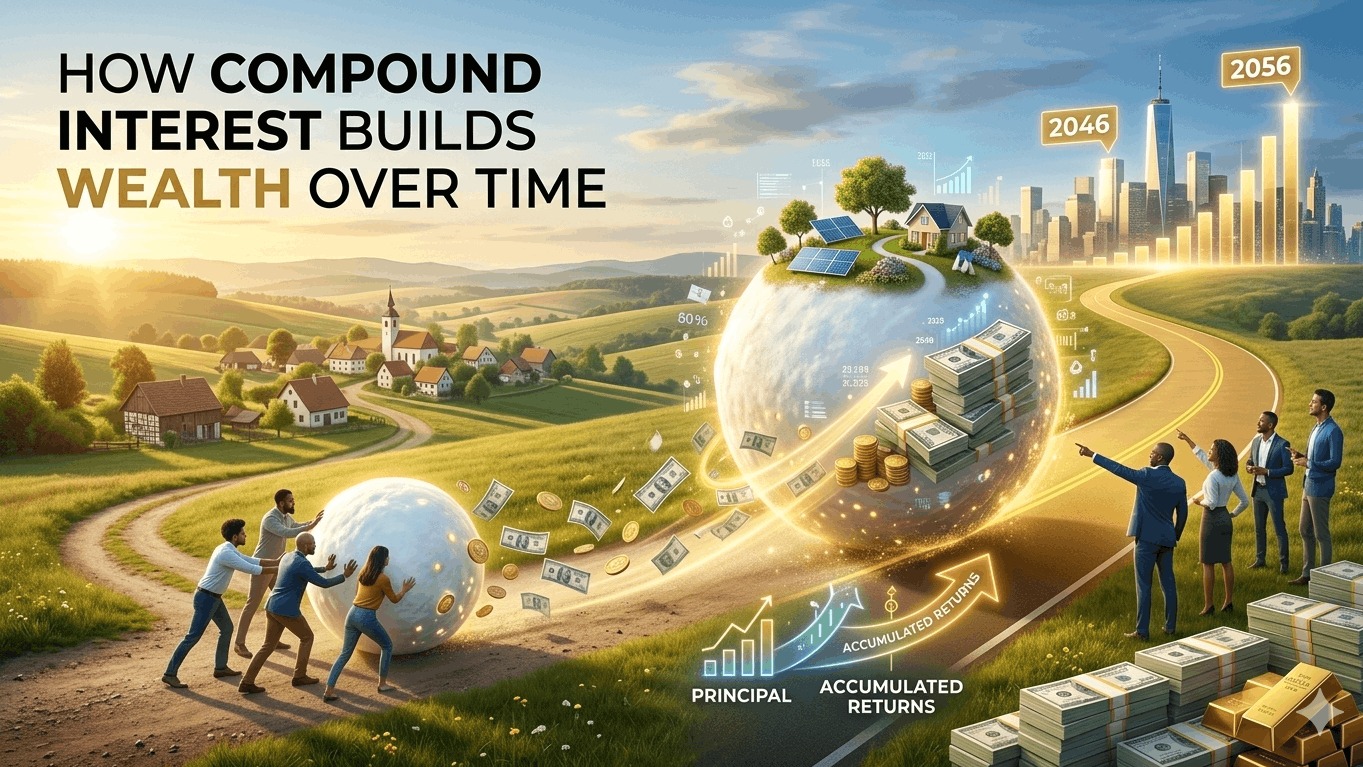
Compound interest is the snowball effect for your money. It’s not about how much you start with; it’s about how long you keep it invested.
Imagine a small snowball rolling down a hill. As it moves, it gathers more snow, getting larger and faster. By the time it reaches the bottom, it's massive. This is the simplest way to understand how compound interest turns small, consistent investments into substantial wealth over the long haul.
The Mechanism: Magic in the Math
The secret lies in investing your returns as well as your original investment.
- Simple Interest: You only earn interest on the money you originally deposited (the principal).
- Compound Interest: You earn interest on your principal and on the accumulated interest from previous periods.
This means that with each compounding period (be it annual, quarterly, or monthly), your interest payment gets larger and larger, accelerating your growth exponentially.
The Compounding Formula:
A = P (1 + rn)nt
- A: The final amount of money accumulated
- P: The principal investment amount
- r: The annual interest rate (as a decimal)
- n: The number of times interest is compounded per year
- t: The number of years the money is invested
The Pillars of Compounding Success
To make the most of this financial phenomenon, you need to understand its key components:
1. The Time Horizon (The Long Hill)
Compound interest is fundamentally a function of time. The longer you allow your money to compound, the more dramatic the final result will be. This is why starting to invest now is far more important than the amount you invest initially. Starting 10 years earlier can mean the difference between a comfortable retirement and a struggle.
2. The Interest Rate (The Snowiness of the Hill)
The rate of return you earn significantly impacts how quickly your wealth grows. Even a small difference (e.g., 6% vs. 8%) in your average annual return can lead to a massive discrepancy in your final portfolio value over 30 or 40 years.
- Note: In the context of 2026, while short-term interest rates are expected to stabilize around 3-3.75%, the long-term historical return of a diversified stock portfolio (like an S&P 500 index fund) is typically used for projecting compound growth (often estimated around 7-10%, before inflation).
3. Contribution Frequency (Consistent Shoveling)
Consistently adding money to your principal—even in small amounts—dramatically enhances the compounding effect. Regularly contributing (e.g., monthly) not only increases the size of your "snowball" but also allows you to capitalize on dollar-cost averaging, lowering your average cost per share over time.
Quotes & Taglines
- "Compound interest is the eighth wonder of the world. He who understands it, earns it... he who doesn't... pays it." — Albert Einstein
- "Wealth is built not by the sprint, but by the marathon of compounding."
- "Start today: The time you lose can never be compounded."
- "Every dollar you invest isn't just a dollar; it's a seed with exponential potential."
- "The magic of compounding is invisible at first, but irresistible in the long run."