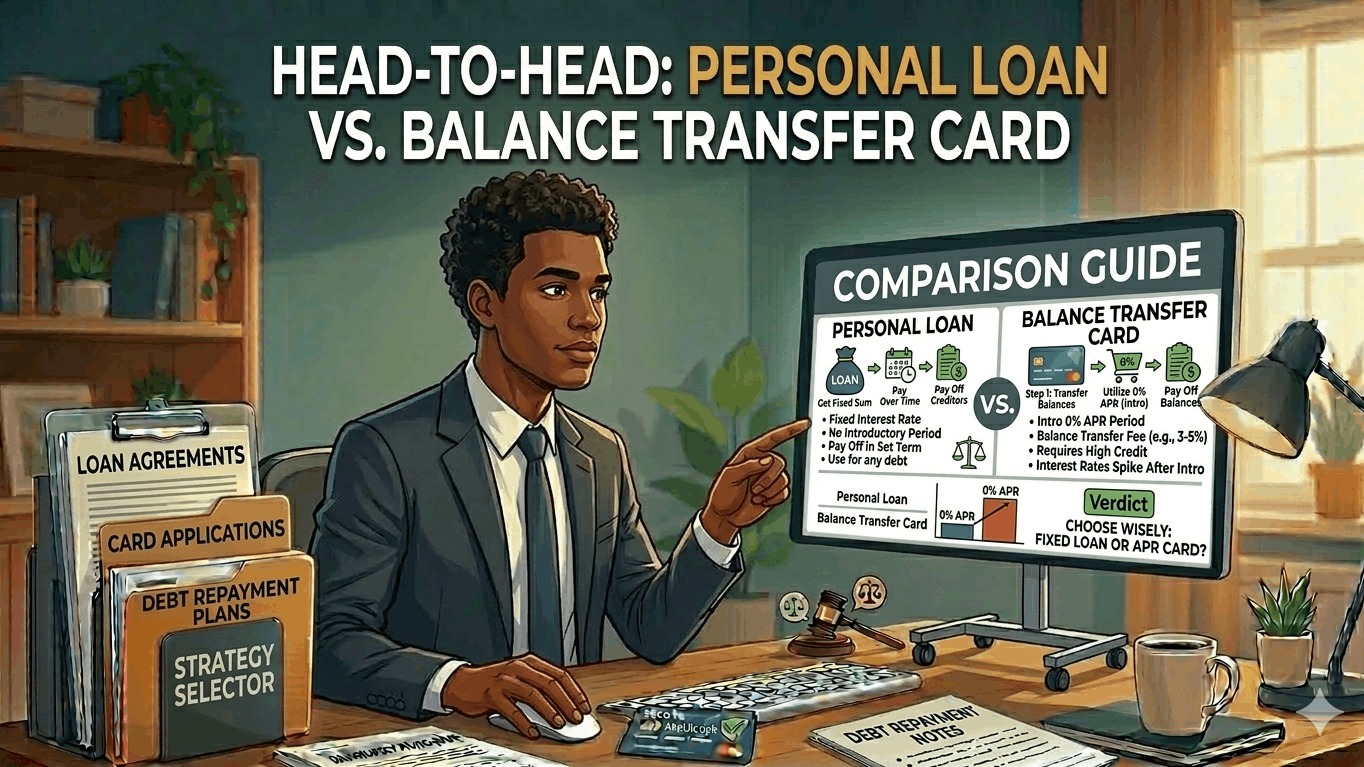
In 2026, with average credit card interest rates sitting at a staggering 21% to 23%, Americans are looking for the most efficient exit strategy for their debt. The two primary weapons are the Personal Loan and the 0% APR Balance Transfer Card.
While both aim to reduce interest and simplify payments, they operate on different timelines and psychological triggers. Choosing the wrong one can lead to "double debt" or wasted fees.
1. At a Glance: The 2026 Comparison Table
| Feature | 0% Balance Transfer Card | Personal Consolidation Loan |
|---|---|---|
| Intro Interest Rate | 0% for 12–21 months | 6.5% – 35% (Fixed) |
| Standard APR | 18% – 29% (after intro) | Remains fixed for life of loan |
| Upfront Fees | 3% – 5% Transfer Fee | 0% – 12% Origination Fee |
| Monthly Payment | Flexible (Minimum required) | Fixed (Must pay set amount) |
| Payoff Deadline | 15–21 months | 2–7 years |
| Credit Needed | Good to Excellent (690+) | Fair to Excellent (600+) |
2. When the Balance Transfer Card Wins
The balance transfer card is a "sprint" tool. It is mathematically the cheapest option if you have a plan to be aggressive.
- The 0% Advantage: For up to 21 months (on cards like the Wells Fargo Reflect® or Citi Diamond Preferred®), every cent of your payment goes to the principal.
- The "Small Debt" Specialist: This is best for balances under $10,000 that can reasonably be paid off in under two years.
- The High-Score Requirement: In 2026, banks have tightened lending. You typically need a score of 690+ to get a high enough credit limit to cover your old debt.
3. When the Personal Loan Wins
The personal loan is a "marathon" tool. It provides stability and a guaranteed light at the end of the tunnel.
- The Fixed Payoff Date: Unlike a credit card, a personal loan has a "closed-end" term. If you have a 36-month loan, you will be debt-free in 3 years.
- The Utilization Spike: This is the "hidden" credit score hack. When you pay off multiple credit cards with a loan, your Credit Utilization drops to zero, which can spike your score by 50+ points in a single month.
- Higher Limits: While credit cards often cap transfer limits at $5,000–$15,000, personal loans (from lenders like SoFi or LightStream) can go up to $100,000.
4. The Fee Trap: Math You Must Check
In 2026, "hidden" fees can eat your interest savings if you aren't careful.
- The 5% Transfer Fee: On a $10,000 transfer, you pay $500 upfront. If you were only paying $50/month in interest on your old card, it would take 10 months just to break even on the fee.
- The Origination Fee: Some personal loans deduct a fee (e.g., 6%) from the payout. If you need exactly $10,000 to pay off cards, you must borrow $10,638 to account for the fee.
5. The Verdict: How to Choose
- Choose the Card if: Your total debt is manageable, your credit is great, and you are disciplined enough to pay more than the minimum every month.
- Choose the Loan if: Your debt is large (over $15k), you need more than 2 years to pay it off, or you prefer the "forced discipline" of a fixed monthly bill that cannot be skipped or lowered.